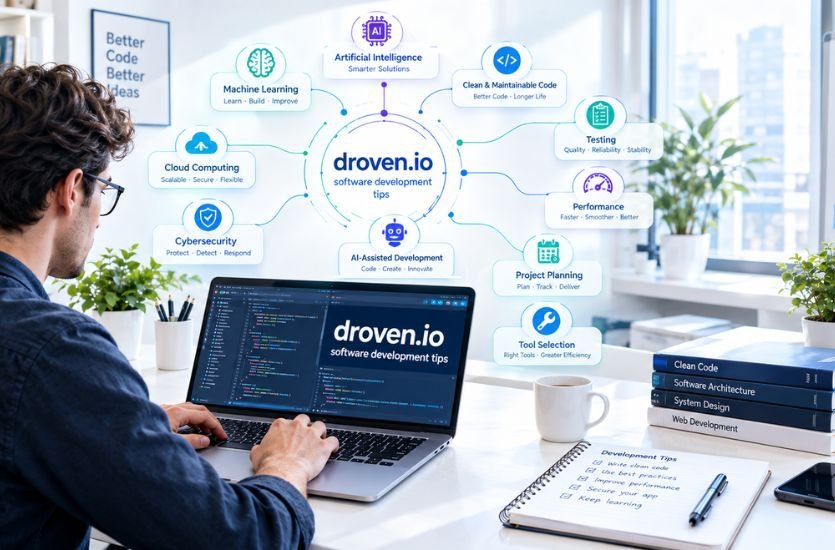
Software development is no longer limited to writing code and making an application run. Modern development involves understanding requirements, selecting appropriate technologies, organizing code, testing features, protecting data, managing changes, and continuously improving the final product. This is why searches for droven. io software development tips often lead to advice covering the entire development process rather than programming syntax alone.
Droven.io is generally presented in current search results as a technology and information resource rather than a traditional coding application or IDE. Its software-development-related content is associated with areas such as programming, web development, app development, development workflows, AI-assisted coding, and related technology subjects. The practical value of these topics comes from applying the underlying principles to real software projects instead of simply copying individual coding suggestions.
The most useful approach is to treat software development as a process. Start with a clear problem, build only what is necessary, write maintainable code, test continuously, consider security from the beginning, and use modern tools without allowing them to replace sound engineering judgment.
Quick Overview of Droven.io Software Development Tips
| Topic | Key Information |
|---|---|
| Focus | Software development and related technology guidance |
| Main Areas | Coding, planning, testing, security, AI-assisted development and workflows |
| Suitable For | Beginners, developers, startups and technology teams |
| Development Approach | Plan, build, test, review, deploy and improve |
| AI Usage | Helpful for assistance, but generated code requires human review |
| Important Practices | Clean code, version control, testing, security and performance |
What Are Droven.io Software Development Tips?
The phrase droven. io software development tips generally refers to practical guidance for improving the way software is planned, developed, tested, secured, deployed, and maintained. Current articles targeting this phrase repeatedly focus on areas such as clean coding, version control, testing, security, performance, AI coding assistants, debugging, architecture, and development workflows.
The important point is that software development is much broader than writing individual functions. A developer can produce code that works while still creating a project that is difficult to maintain, insecure, poorly documented, or expensive to improve.
Good development practices therefore focus on the entire life cycle of an application. The objective is to create software that solves the intended problem while remaining understandable and adaptable as requirements change.
Start With a Clear Software Plan
One of the most important software development tips is to understand the problem before writing code. Developers sometimes begin programming immediately because coding feels like progress. However, unclear requirements can result in wasted work when the team eventually discovers that the application does not solve the intended problem.
Start by defining what the software needs to accomplish. Identify the people who will use it, the primary tasks they need to perform, and the results the application should provide.
Consider an appointment-booking application. Its initial requirements might include user accounts, available appointments, booking confirmation, cancellation, and basic notifications. These requirements create a clearer foundation than simply deciding to build an application and adding features randomly.
Planning does not require a huge document. A small project can often begin with a short description of its purpose, core features, technical requirements, and expected users.
Build an MVP Before Adding Everything
A minimum viable product can help developers avoid spending excessive time on features that may not be necessary. The first version should solve the primary problem with a manageable collection of features.
Once the basic application works, developers can learn from testing and user feedback. Additional features can then be introduced according to actual requirements rather than assumptions.
This approach also makes debugging easier because the initial system contains fewer moving parts.
Choose Technology Based on Requirements
The newest programming language or framework is not automatically the right choice for every project. Technology decisions should consider the application’s requirements, the team’s existing knowledge, available libraries, integrations, documentation, maintenance needs, and expected future development.
A technology that looks impressive but lacks suitable documentation or creates unnecessary complexity can increase the cost of maintaining the project.
A practical technology decision is therefore based on the problem being solved rather than popularity alone.
Write Clean and Maintainable Code
Software can work correctly while still being difficult to maintain. Clean code makes it easier for developers to understand existing functionality, locate problems, add features, and collaborate with other programmers.
Use Clear Names
Variables, functions, classes, and files should have names that communicate their purpose. A name such as customerName immediately provides more information than an unclear abbreviation.
Clear naming reduces the amount of explanation required elsewhere in the code. When developers return to a project months later, meaningful names can make the existing logic much easier to understand.
Keep Functions Focused
A function should generally have a clear responsibility. A function responsible for authentication should not also handle unrelated payment processing and email notifications.
Separating responsibilities makes individual components easier to test and modify. It also reduces the chance that changing one part of the system will unexpectedly affect unrelated functionality.
Avoid Unnecessary Complexity
Developers sometimes make code more complicated than necessary because they want to demonstrate advanced techniques. Complexity can create additional maintenance work when a simpler approach would have solved the same problem.
Readable and straightforward code is often easier to debug than code that uses unnecessary abstractions or complicated logic.
Use Version Control From the Beginning
Version control is a fundamental part of modern software development. Git allows developers to track changes, experiment safely, collaborate with other programmers, and return to earlier versions when necessary.
It is better to introduce version control at the beginning of a project rather than after significant development has already occurred.
Focused commits are especially useful. A commit that represents one logical change is easier to understand than a large commit containing unrelated modifications.
Good commit messages can also provide useful project history. Instead of vague descriptions, developers can describe what was changed and why the change was necessary.
For collaborative projects, teams should also establish a sensible approach to branches, code reviews, merging, and release management.
Test Software Throughout Development
Testing should not be treated as an activity that happens only immediately before launch. Testing during development helps developers discover problems while the relevant code is still fresh in their minds.
A feature that works under normal conditions should also be tested with invalid or unexpected input.
For example, a login system should be checked with correct credentials, incorrect credentials, missing information, expired sessions, and other relevant conditions. A successful test of one scenario does not prove that the entire feature works correctly.
Test Critical User Flows
Different applications have different high-risk workflows. An ecommerce system may need particular attention around login, checkout, payments, and order confirmation.
A SaaS application may need extensive testing around authentication, permissions, billing, customer data, and the main service provided to users.
Testing priorities should therefore reflect the consequences of failure.
Fix the Root Cause of Bugs
When a bug appears, developers should investigate why it happened rather than simply hiding its visible symptoms.
A temporary workaround might make one error disappear while leaving the underlying problem untouched. Understanding the root cause can produce a more reliable fix and reduce the likelihood of similar bugs returning.
After fixing a problem, test the affected functionality again and consider whether related areas could also have been affected.
Build Security Into the Development Process
Security should be considered throughout development instead of being added immediately before deployment.
Applications often handle user accounts, personal information, payment details, credentials, or other sensitive data. Weak security practices can expose this information or allow unauthorized access.
Protect Sensitive Information
Only collect information that the application actually needs. Sensitive information should not unnecessarily appear in logs, error messages, public responses, or source-code repositories.
Authentication and authorization should also be treated as separate concepts. Authentication establishes who a user is, while authorization determines what that user is allowed to access.
Protect API Keys and Secrets
Passwords, API keys, database credentials, and other secrets should not be hard-coded into publicly accessible source code.
Environment variables or dedicated secrets-management systems can help keep configuration separate from application code.
Developers should also inspect repositories before sharing or publishing projects to ensure that sensitive values have not accidentally been committed.
Check Third-Party Dependencies
External packages can save considerable development time, but they can also introduce security or maintenance concerns.
Before adding a dependency, developers should consider whether it is actually necessary, whether it is actively maintained, and whether it fits the project’s requirements.
Security warnings and outdated dependencies should also be investigated rather than ignored.
Use AI Coding Tools Carefully
AI-assisted development has become an important part of modern software workflows. Current discussions surrounding Droven.io software development tips also include AI coding assistants and their role in development.
AI can be useful for explaining unfamiliar code, suggesting functions, generating repetitive code, creating test ideas, and helping developers investigate errors.
However, generated code should not automatically be treated as production-ready.
An AI system can generate code that looks convincing while containing logical mistakes, inappropriate dependencies, inefficient approaches, or security problems.
Keep Human Review in the Process
Developers should understand what AI-generated code does before incorporating it into an application.
Check whether the solution actually meets the original requirement. Review its dependencies, examine error handling, test expected inputs and outputs, and consider unusual conditions.
AI is most useful when it accelerates development while the developer remains responsible for technical decisions.
Test AI-Generated Code
Testing is especially important when code has been generated or significantly modified by an AI tool.
Developers should test both successful and unsuccessful scenarios. They should also consider whether the generated code introduces new security risks or behaves differently from what the application requires.
The goal is not to avoid AI. The goal is to use it responsibly.
Measure Performance Before Optimizing
Performance optimization is another important part of software development, but optimization should be based on measurements rather than assumptions.
An application can feel slow for many different reasons. A database query may be inefficient, a large resource may be loading unnecessarily, an API may be taking too long to respond, or the application may be performing the same calculation repeatedly.
Developers should identify the actual bottleneck before changing code.
Set Practical Performance Targets
Performance targets can make optimization more objective. Depending on the application, developers might monitor response times, page loading behavior, database performance, resource usage, or API latency.
After making an optimization, measure the result again.
If the application does not become measurably better, the change may not have addressed the real problem.
Avoid Premature Optimization
Trying to optimize every line of code can consume time without producing meaningful improvements.
It is generally more useful to identify the areas that have the greatest effect on users or system resources and focus improvement efforts there.
Choose Development Tools Carefully
Modern developers have access to a large number of editors, repositories, testing tools, API clients, containers, cloud services, and automation platforms.
More tools do not automatically mean better development.
A small web project might need a code editor, Git, a repository, browser-development tools, and testing tools. A larger infrastructure project could require containers, continuous integration, deployment automation, monitoring, and other systems.
The correct toolset depends on the project.
Current third-party discussions around Droven.io-related developer resources mention tools such as code editors, GitHub, Docker, Postman, Kubernetes, and project-management platforms, but these should be understood as external development tools rather than assuming they are products owned by Droven.io.
Improve Debugging Skills
Debugging is one of the most valuable skills a developer can develop.
When something goes wrong, avoid changing several parts of the application randomly. Start by reproducing the problem consistently.
Then identify where the unexpected behavior begins.
Logs, debugger tools, error messages, test cases, and controlled experiments can help narrow down the cause.
A systematic debugging process is usually more effective than guessing. Developers should form a hypothesis, test it, examine the result, and continue narrowing the problem until the root cause becomes clear.
This skill becomes increasingly important as applications grow more complicated.
Keep Documentation Useful
Documentation helps developers understand how an application works and how it should be maintained.
Useful documentation might explain how to install the project, configure the development environment, run tests, deploy the application, understand important architecture decisions, or troubleshoot common problems.
Documentation does not need to describe every line of code.
Instead, it should provide information that another developer would reasonably need to work with the project.
Good documentation can also help the original developer. After several months, it is easy to forget why a particular technical decision was made.
Think About Deployment Early
Software development does not end when code works on a developer’s computer. The application eventually needs to operate in a real environment.
Deployment planning should consider configuration, databases, dependencies, security, monitoring, backups, and rollback procedures where appropriate.
For larger projects, automated deployment and continuous integration can help teams test and release changes consistently.
Smaller projects do not necessarily need complicated infrastructure. Developers should avoid introducing unnecessary systems simply because they are popular.
The deployment approach should match the application’s actual requirements.
Monitor Software After Launch
A release is not the end of software development.
Real users can reveal problems that were difficult to identify during development. They may encounter unusual workflows, unexpected traffic levels, device differences, or confusing parts of the interface.
Monitoring can help developers identify errors, performance problems, failed requests, and other issues.
User feedback can also reveal problems that technical monitoring cannot detect. A feature may work correctly from the application’s perspective while still being confusing or inconvenient for users.
Successful development therefore continues after deployment.
Keep Improving the Development Process
Software development itself should improve over time.
After completing a project or major feature, developers can examine what worked well and what caused unnecessary problems.
Perhaps requirements were unclear, testing began too late, code reviews were inconsistent, deployment required too many manual steps, or documentation was difficult to maintain.
These observations can be used to improve the next development cycle.
The most valuable software development habits are often small ones repeated consistently. Clear planning, focused commits, readable code, regular testing, security checks, useful documentation, and thoughtful reviews can have a significant cumulative effect.
How Beginners Can Apply Droven.io Software Development Tips
Beginners do not need to learn every framework, tool, and development practice simultaneously.
Start with programming fundamentals and learn how software actually works. Once the basics are comfortable, build small projects that solve clear problems.
Use Git from the beginning so version control becomes a normal part of the workflow.
Test features while building them instead of waiting until the end.
When using AI coding tools, ask for explanations and suggestions, but make sure you understand the resulting code before depending on it.
Most importantly, learn from mistakes. Bugs, failed approaches, and difficult projects can become valuable learning opportunities when developers investigate why something went wrong.
Frequently Asked Questions
What Are Droven.io Software Development Tips?
Droven.io software development tips refers to practical development guidance associated with topics such as planning, coding, testing, version control, security, performance, AI-assisted development, and software workflows. Current search results generally present these ideas as educational or editorial content rather than as features of a dedicated coding application.
Is Droven.io a Software Development Tool?
Current search results commonly describe Droven.io as an information or technology resource rather than a conventional software-development tool, IDE, or programming environment. Developers should therefore distinguish between development advice associated with Droven.io and the actual tools used to write and deploy software.
Are Droven.io Software Development Tips Useful for Beginners?
The principles associated with the keyword can be useful for beginners because they focus on fundamental habits such as planning, readable code, version control, testing, debugging, security, and continuous learning. These principles can apply across many programming languages and frameworks.
Can AI Replace Software Developers?
AI coding tools can assist with programming tasks, but generated code still requires human understanding, review, testing, and validation. AI can accelerate certain development activities without removing the need for developers to make technical decisions.
Why Is Version Control Important?
Version control provides a history of project changes and allows developers to collaborate, experiment, identify when changes were introduced, and restore earlier versions when necessary. It becomes particularly valuable as a project grows or multiple developers begin working together.
What Is the Most Important Software Development Practice?
There is no single practice that solves every development problem. Strong software development usually comes from combining clear requirements, maintainable code, testing, security, version control, appropriate tools, monitoring, and continuous improvement.
Final Thoughts
The main lesson behind droven. io software development tips is that good development is about much more than writing code quickly. A reliable application begins with a clear problem and continues through careful planning, implementation, testing, security, deployment, monitoring, and improvement.
Developers should choose technologies according to project requirements rather than trends. They should write code that other people can understand, use version control from the beginning, test important workflows, protect sensitive information, and investigate bugs systematically.
AI-assisted coding can make development faster, but human review remains important. Similarly, performance optimization should be based on measurements rather than assumptions, while development tools should be selected according to actual project needs.
When these habits become part of the normal workflow, developers can create software that is easier to understand, safer to operate, easier to maintain, and more capable of adapting to future requirements.
READ MORE : GFXRobotection AI Software by GFXMaker
READ MORE : Is 2579xao6 Easy to Learn

One thought on “Droven.io Software Development Tips: A Practical Guide”