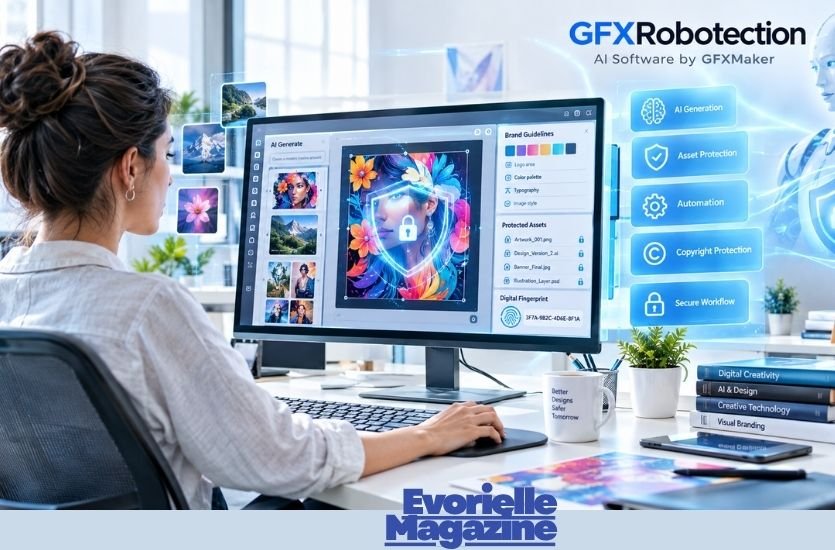
Artificial intelligence is changing the way digital graphics are created, edited, managed, and distributed. Designers can now generate concepts faster, automate repetitive tasks, and produce multiple variations of visual content with less manual work. At the same time, the growth of AI has created new concerns about artwork copying, automated scraping, ownership, and digital asset security. This is where GFXRobotection AI software by GFXMaker has attracted attention.
GFXRobotection is described online as a combination of AI-assisted graphic design, creative automation, digital asset management, and artwork protection. Some descriptions focus on its ability to generate and process graphics, while others emphasize protection against unauthorized copying and AI-related scraping. GFXMaker’s own published material presents GfxRoboTection as a production-oriented graphics system that combines generative AI, brand rules, asset validation, permissions, and workflow controls.
However, there is an important distinction between what is claimed about GFXRobotection and what has been independently verified. Public information about its software availability, pricing, technical documentation, and some advanced protection features remains limited. Several independent articles have specifically highlighted this verification gap.
For that reason, this guide examines what GFXRobotection is reported to do, how its proposed workflow works, who may use it, what its reported features mean, and what potential users should verify before relying on it.
Quick Facts About GFXRobotection
| Detail | Information |
|---|---|
| Software name | GFXRobotection |
| Associated with | GFXMaker |
| Main area | AI graphics and creative asset management |
| Reported capabilities | AI generation, editing, automation, brand controls and asset validation |
| Protection focus | Digital asset security and reported artwork protection |
| Intended users | Designers, freelancers, studios, agencies and creative teams |
| Availability | Public availability is not clearly independently verified |
| Pricing | Specific public pricing remains unclear |
| Verification status | Several major claims remain independently unverified |
What Is GFXRobotection AI Software by GFXMaker?
GFXRobotection AI software by GFXMaker is presented online as an AI-powered graphics and digital asset platform. Its reported purpose goes beyond simply generating pictures. The software is described as combining creative generation with production controls, asset management, brand enforcement, and security-related features.
According to GFXMaker’s current product description, GfxRoboTection combines generative models, rule-based validators, and asset management. It is described as being suitable for freelancers and studios that need repeatable graphics production while maintaining brand standards. The description also mentions GPU acceleration, customizable constraints, asset libraries, permissions, and audit trails.
Other online descriptions give GFXRobotection a somewhat different identity. Instead of concentrating mainly on production workflows, they describe it as a system designed to protect digital artwork from unauthorized use, automated scraping, and AI analysis.
This difference is important. Readers should not automatically assume that every feature mentioned across different websites belongs to one fully documented product. Some information comes directly from GFXMaker, while other claims come from third-party articles.
How Does GFXRobotection Work?
The reported GFXRobotection workflow is based around combining AI generation with controlled production and asset management.
A typical workflow described by GFXMaker begins with a user providing brand assets, a creative brief, or a template. The system can then generate several graphic candidates using AI. After generation, the reported rule engine checks the output against predefined requirements such as brand colors, layouts, or logo placement. A designer can review the results before selecting an approved version.
The final asset can then be prepared for web or print use. GFXMaker’s description also says that the system can validate files, manage versions, maintain an asset library, and record production activity through audit information.
This proposed workflow is different from a simple text-to-image generator. Instead of focusing only on producing an image, it attempts to address what happens before and after generation.
For a professional design team, that distinction could matter because creating an image is only one part of the production process. A finished campaign may require multiple sizes, consistent branding, controlled permissions, file validation, version management, and organized storage.
AI Graphic Design GFXRobotection
The phrase AI graphic design GFXRobotection is used online to describe the creative side of the software.
AI-assisted graphic design can help users generate concepts, experiment with different visual directions, and automate repetitive production work. In a professional environment, this can potentially reduce the amount of time spent on routine modifications.
GFXMaker describes GFXRobotection as capable of generating and editing visual assets while applying brand rules and production controls. The published description also mentions custom constraints that can be used to control elements such as layouts, colors, and logo placement.
The potential advantage is consistency. A designer working alone may be able to maintain standards manually, but a larger team producing hundreds of graphics may benefit from automated checks.
For example, a marketing department might need dozens of social media images based on the same campaign. Rather than manually checking every asset for brand compliance, an automated validation system could potentially identify certain inconsistencies before publication.
However, AI generation does not remove the need for human review. Creative quality, context, visual hierarchy, messaging, and brand suitability can still require human judgment.
GFXRobotection as Graphic Design Software
Some websites refer to graphic design software GFXRobotection as an AI tool intended to make the design process easier.
An older GFXMaker-related article describes GFXRobotection as software that can create graphics according to user instructions and emphasizes automation and ease of use.
The newer GFXMaker description is more detailed and positions the system around production-ready graphics, asset management, brand enforcement, and controlled workflows.
This suggests that GFXRobotection is being presented as more than a basic image generator. Nevertheless, users should verify the actual interface, supported file formats, editing capabilities, and available tools before treating it as a replacement for established professional design applications.
What Does GFXRobotection Protect?
One of the most interesting parts of the GFXRobotection discussion is its reported focus on protecting digital artwork.
Several third-party articles describe features such as digital fingerprints, ownership information, web monitoring, and alerts related to unauthorized use. Some descriptions also suggest that the technology may be intended to make automated AI analysis more difficult.
These concepts are relevant because digital artwork can be copied easily once it is published online.
However, users should understand that digital protection does not mean absolute protection from copying. A publicly displayed image can potentially be screenshotted, photographed, downloaded, recreated, cropped, compressed, or manually reproduced.
A technical protection system may make certain types of unauthorized use more difficult to detect or automate, but it cannot guarantee that artwork will never be copied.
This is why claims about protection should be evaluated according to the exact technology being used and the evidence supporting its effectiveness.
GFXRobotection and AI Artwork Protection
The relationship between GFXRobotection and AI artwork protection is one of the reasons the keyword has become interesting.
Generative AI has increased concerns among artists about how publicly available artwork may be collected and analyzed. Some GFXRobotection descriptions position the software as an attempt to address this problem.
Third-party material has described features such as invisible fingerprints, ownership metadata, monitoring, and detection of unauthorized copies.
However, independent documentation explaining exactly how these technologies work remains limited. Questions about which AI systems have been tested, how protection survives compression, whether modifications remain invisible, and how reliably copied artwork can be detected are important.
A serious evaluation would require technical documentation or independent testing rather than relying only on promotional descriptions.
Reported Features of GFXRobotection
GFXMaker’s current description attributes several features to GfxRoboTection. These include AI-based image generation, editing, brand-rule enforcement, asset validation, role-based permissions, encrypted storage, audit trails, API integration, GPU acceleration, and asset management.
The product is also described as supporting model fine-tuning using labeled company data. If available in practice, such a capability could allow organizations to adapt AI workflows to their own visual requirements.
Another reported feature is the ability to maintain controlled asset workflows. This could be useful when several people are working on the same campaign because access and version information can potentially be managed centrally.
It is important, however, to treat these as reported product capabilities rather than independently demonstrated features. Public evidence currently does not establish every one of these functions through independent testing.
Who Could Use GFXRobotection?
The reported positioning of GFXRobotection makes it potentially relevant to several groups.
Freelance designers could use an AI-assisted system to speed up repetitive creative tasks while keeping their projects organized. A freelancer handling multiple clients may particularly value asset management and controlled access.
Design studios could potentially use production rules and asset libraries to keep multiple designers working consistently. A standardized workflow can reduce inconsistencies when a team produces a large volume of graphics.
Marketing agencies may also find the concept relevant because campaigns frequently require many visual variations. Social media graphics, advertisements, banners, promotional images, and other campaign materials often need to follow specific brand guidelines.
Independent artists may be more interested in the reported protection side. For them, the key question would be whether the protection technology provides meaningful benefits without damaging image quality or interfering with normal publishing workflows.
GFXRobotection for Professional Designers
Professional designers should evaluate GFXRobotection differently from casual users.
A professional workflow normally includes an original master file, editable project files, export versions, backups, client approvals, and final delivery files. A protection system should fit into that process rather than becoming a single point of dependence.
A sensible approach would be to keep original artwork separately and use a distribution copy when testing any protection technology. This ensures that the master file remains available if the processing system changes the image or becomes unavailable.
Designers should also compare the original and processed versions carefully. Resolution, color, transparency, metadata, compression, fine details, and print quality can all matter.
Does GFXRobotection Replace Photoshop?
There is currently no strong basis for assuming that GFXRobotection completely replaces established professional design software.
Traditional applications are often designed for detailed illustration, typography, vector editing, advanced retouching, layer management, and precise manual control.
An AI-oriented system may instead focus on generation, automation, production management, and asset workflows.
The two approaches can therefore potentially complement one another.
Until GFXRobotection’s complete product environment and integrations are independently documented, it is more accurate to describe it as a potential AI-assisted graphics and asset-management solution rather than a confirmed replacement for professional design software.
GFXRobotection Pricing and Plans
Pricing is one of the areas where public information remains incomplete.
GFXMaker’s current article describes Starter, Team, and Enterprise-style options and presents the software as scalable from individual creators to larger organizations. It also mentions options involving cloud, local GPU acceleration, and enterprise deployment.
However, specific public pricing is not clearly established in the available material.
Independent reviews have also highlighted inconsistent or unclear pricing information.
For that reason, readers should not rely on third-party articles that provide exact subscription prices unless those prices can be confirmed directly through a current official source.
Is There a GFXRobotection Download?
People searching for GFXRobotection may naturally expect to find a download page or application installer.
This is another area requiring caution.
Independent research has reported difficulty verifying a clearly documented official download, public software dashboard, conventional app-store listing, or comprehensive technical documentation.
That does not necessarily prove that no software exists. A private, early-stage, invitation-only, or unreleased product could have limited public infrastructure.
However, users should avoid downloading software from random third-party websites simply because they advertise a GFXRobotection installer.
Before installing any unfamiliar application, users should confirm the publisher, domain, file authenticity, privacy terms, and security information.
Is GFXRobotection Legit?
The available evidence does not justify a simple yes-or-no conclusion.
GFXMaker and GFXRobotection websites are publicly accessible, and multiple pages describe the technology. The product concept itself is technically plausible because AI graphic generation, digital asset management, provenance technologies, and automated artwork monitoring are all established areas of technology.
The unresolved issue is whether GFXRobotection itself currently provides all the capabilities attributed to it.
Independent articles have pointed to the absence of clearly verified software downloads, detailed technical documentation, transparent pricing, and extensive independent testing.
Therefore, the most accurate description is that GFXRobotection is an online-described AI graphics and digital-asset protection concept whose full product capabilities and commercial availability remain insufficiently independently verified.
That wording avoids both unsupported endorsement and unsupported accusations.
What Should Users Verify Before Using GFXRobotection?
Anyone considering the platform should first investigate how uploaded files are handled.
Important questions include where images are stored, whether files are encrypted, how long they are retained, whether uploaded artwork can be used for AI training, who can access project files, and whether users can permanently delete their data.
Users should also review ownership and licensing terms. This is particularly important for client artwork because the designer may not personally own all rights to the material being uploaded.
Testing with a low-risk image is another sensible approach. A sample project can reveal whether the system actually fits the user’s workflow before valuable artwork is uploaded.
Users should also compare the original and processed versions to identify any changes in quality, metadata, color, resolution, transparency, or file compatibility.
Limitations of GFXRobotection
The most significant limitation at present is not necessarily a technical failure. It is the lack of sufficient public verification.
The online descriptions are not completely consistent. Some sources describe GFXRobotection primarily as AI graphic-design software, while others emphasize artwork protection and monitoring.
Another limitation is the absence of extensive independent testing. A product can sound technically impressive on paper while behaving differently in real-world environments.
There is also the broader limitation of digital artwork protection itself. No online protection system should be assumed to make an image impossible to copy.
These limitations do not automatically mean the underlying concept is ineffective. They simply mean users should evaluate the actual product carefully rather than relying entirely on online descriptions.
GFXRobotection vs Traditional Design Tools
Traditional design software generally provides precise control over the creative process. Designers can manually edit layers, adjust typography, manipulate vectors, retouch photographs, and make detailed changes.
GFXRobotection is described more around AI assistance, automation, asset validation, brand compliance, and managed production.
This creates a different approach to design.
A traditional workflow might prioritize manual control from beginning to end, while an AI-assisted workflow can automate some early-stage concepts and repetitive production tasks.
For professional teams, the most useful approach may not be choosing one category exclusively. AI tools can potentially handle repetitive tasks while designers retain control over important creative decisions.
Frequently Asked Questions
What is GFXRobotection AI software by GFXMaker?
GFXRobotection AI software by GFXMaker is described online as an AI-powered graphics and digital asset system combining creative generation, automation, asset management, and reported protection features. GFXMaker’s current description emphasizes production workflows, brand controls, validation, permissions, and audit trails.
What is AI graphic design GFXRobotection?
AI graphic design GFXRobotection refers to the reported use of artificial intelligence for creating and processing graphics while supporting production controls and brand consistency. The exact publicly available feature set should be confirmed before relying on it professionally.
Is GFXRobotection graphic design software?
It is described as graphic design and AI graphics software by several sources. However, descriptions differ between websites, with some focusing more heavily on digital artwork protection.
Can GFXRobotection protect artwork from AI scraping?
Some online descriptions claim that GFXRobotection provides artwork protection against AI scraping and unauthorized use. However, the precise technical implementation and effectiveness of those protection mechanisms have not been sufficiently independently documented.
Is GFXRobotection free?
A clearly verified public free version or transparent public pricing structure has not been established in the sources reviewed. GFXMaker’s description refers to different plan levels but does not provide enough independently verifiable pricing information.
Does GFXRobotection replace professional graphic design software?
There is not enough evidence to conclude that it replaces established professional design applications. Its reported focus on AI generation, automation, asset management, and production controls suggests that it may serve a different or complementary role.
Should designers upload valuable artwork to GFXRobotection?
Users should first verify the platform’s privacy policy, file-retention practices, ownership terms, security controls, and actual product availability. Testing with non-sensitive artwork is a safer starting point than immediately uploading valuable client material.
Final Thoughts on GFXRobotection AI Software by GFXMaker
GFXRobotection AI software by GFXMaker is an interesting technology concept because it brings together two areas that are becoming increasingly important: AI-assisted graphic production and digital artwork protection.
GFXMaker describes GfxRoboTection as a production-focused system involving AI generation, brand rules, asset validation, permissions, asset management, and audit trails. Other websites place greater emphasis on fingerprinting, artwork monitoring, ownership information, and protection against unauthorized AI-related use.
The biggest issue is the gap between these ambitious descriptions and the amount of independently verifiable product evidence currently available. Public information about software availability, pricing, technical documentation, and some protection features remains limited.
For that reason, anyone researching GFXRobotection should approach the technology with reasonable caution. The underlying ideas are relevant to modern digital design, but claims about a specific product should be evaluated using current documentation, demonstrations, privacy information, and independent testing.
For designers, the most important question is ultimately not whether a software tool uses AI. It is whether the tool can genuinely improve the creative workflow while preserving quality, ownership, privacy, and control over valuable digital assets.
READ MORE ABOUT : Is 2579xao6 Easy to Learn
READ MORE ABOUT : How Much Does the 493xds5.0 Software Cost

One thought on “GFXRobotection AI Software by GFXMaker: Complete Guide”