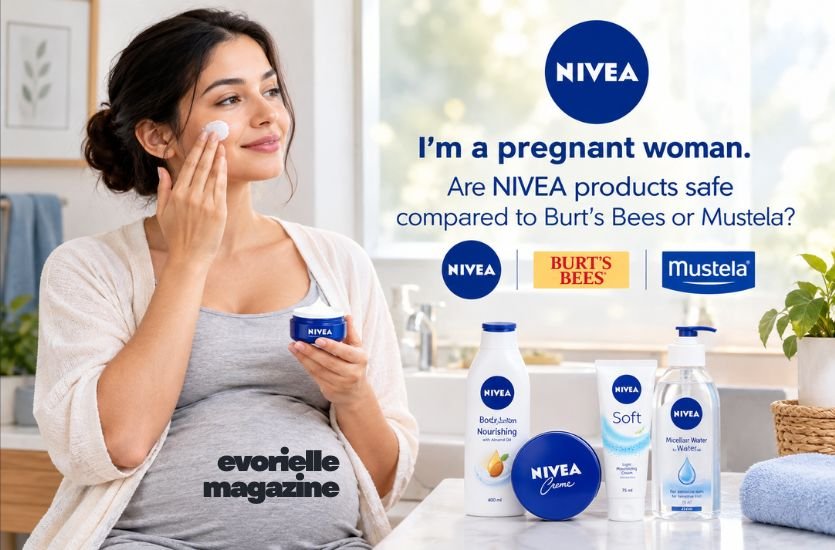
Pregnancy can make even familiar skincare products feel suddenly complicated. A moisturizer that has been part of your routine for years may start raising questions once you become pregnant, especially when you see different advice about ingredients, fragrances, essential oils, retinol, and other skincare ingredients online. If you are wondering, “I’m a pregnant woman. Are NIVEA products safe compared to Burt’s Bees or Mustela?”, the most important thing to understand is that pregnancy skincare safety is determined primarily by the specific formula and its ingredients rather than simply by the brand name.
NIVEA, Burt’s Bees, and Mustela all offer moisturizing products that can fit into a pregnancy skincare routine. NIVEA has a large range of everyday moisturizers, Burt’s Bees has pregnancy-focused products such as Mama Belly Butter, and Mustela has an extensive maternity range designed specifically around pregnancy and postpartum skincare. However, that does not mean every product from any of these brands should automatically be considered appropriate for every pregnant woman.
The American Academy of Dermatology recommends paying close attention to skincare ingredients during pregnancy and avoiding certain ingredients, including retinoids and hydroquinone. It also recommends keeping pregnancy skincare relatively simple, with cleansing, moisturizing, and sun protection forming the foundation of a routine.
Quick Overview
| Detail | Information |
|---|---|
| Topic | Pregnancy-safe skincare |
| Main brands compared | NIVEA, Burt’s Bees, Mustela |
| Main concern | Skincare safety during pregnancy |
| Best basic approach | Check individual ingredients and product formulas |
| Main ingredients requiring caution | Retinoids, hydroquinone and certain high-strength treatments |
| Suitable routine | Gentle cleansing, moisturizing and sun protection |
| Medical guidance | Consult an obstetrician or dermatologist for individual concerns |
Why Skincare Becomes More Important During Pregnancy
Pregnancy can change the way your skin looks and feels. Hormonal changes may contribute to dryness, sensitivity, acne, pigmentation, melasma, and stretch marks. Some women notice that products they previously tolerated suddenly cause redness, itching, burning, or discomfort.
The American Academy of Dermatology explains that pregnancy can trigger several skin changes, including acne, melasma, hyperpigmentation, stretch marks, dry skin, and increased sensitivity. Because of these changes, dermatologists generally recommend keeping the routine simple and focusing on gentle products.
This is one reason the question of whether NIVEA is safe during pregnancy cannot be answered simply with a yes or no for the entire brand. NIVEA sells moisturizers, body lotions, facial products, anti-aging products, sunscreens, cleansers, and other treatments. Those products can have very different ingredient lists.
The same principle applies to Burt’s Bees and Mustela. A pregnancy-specific product may have a formulation designed for expectant mothers, while another product from the same company may target an entirely different skincare concern.
Is NIVEA Safe During Pregnancy?
NIVEA states in its official FAQ that its cosmetic products undergo safety and skin-compatibility evaluations before being introduced to the market. The company specifically says its cosmetic products are considered safe for pregnant and breastfeeding women. It also advises women to seek guidance from a doctor or midwife if they have individual concerns.
That is useful information, but it should not be interpreted as meaning that every NIVEA product is identical or appropriate for every pregnancy situation.
NIVEA has a very large product range. A simple body moisturizer and a specialized anti-aging treatment may contain completely different active ingredients. Therefore, checking the specific product remains the sensible approach.
For ordinary moisturizing, NIVEA can be a practical option. The brand offers products such as NIVEA Creme, NIVEA Soft, body lotions, and other moisturizing formulas designed to support dry or normal skin.
NIVEA also specifically discusses pregnancy body care. Its official body-care FAQ says that NIVEA Q10 Firming Body Oil can be used for massaging the belly during pregnancy.
For a pregnant woman mainly looking for everyday hydration, this means NIVEA does not need to be automatically removed from the bathroom shelf simply because the pregnancy test is positive.
What About NIVEA Anti-Aging Products?
This is where more careful label checking becomes important.
Some anti-aging skincare products contain retinoids or retinol. Retinoids are vitamin A derivatives used for acne, pigmentation, wrinkles, and skin texture. The American Academy of Dermatology states that retinoids should not be used during pregnancy.
Therefore, a pregnant woman should not assume that an NIVEA product is suitable simply because another NIVEA moisturizer is suitable.
The same rule applies to other brands. If a product from NIVEA, Burt’s Bees, Mustela, or another company contains an ingredient that healthcare professionals recommend avoiding during pregnancy, the brand name does not make that ingredient acceptable.
This is one of the most important lessons when comparing pregnancy skincare: compare formulas, not logos.
Is Burt’s Bees Safe During Pregnancy?
Burt’s Bees is another popular option for people who prefer products positioned around naturally derived ingredients. The brand also offers products specifically intended for pregnancy.
One of its best-known maternity products is Mama Belly Butter. The product is designed for use on the belly during pregnancy and contains moisturizing ingredients such as sunflower seed oil, coconut oil, sweet almond oil, shea butter, jojoba butter, cocoa butter, and vitamin E.
This type of formulation makes sense for someone whose main goal is keeping stretching skin moisturized and comfortable.
However, the word “natural” should not be treated as a guarantee of pregnancy safety. Natural ingredients can still cause irritation, allergic reactions, or sensitivity. Pregnancy can also make the skin more reactive than usual.
That means a pregnant woman should still read the ingredient list on Burt’s Bees products just as she would with NIVEA or any other skincare brand.
Is Burt’s Bees Better Than NIVEA During Pregnancy?
There is no strong basis for saying that Burt’s Bees is automatically safer than NIVEA for every pregnant woman.
Burt’s Bees has a useful advantage for consumers who specifically want a pregnancy-oriented product. Mama Belly Butter, for example, is designed around the needs of the growing belly.
NIVEA, on the other hand, has a much broader everyday skincare range and may be more convenient for someone who simply wants an affordable moisturizer.
The better choice depends on what you are trying to accomplish.
If you want a straightforward everyday body moisturizer, a suitable NIVEA product may be enough. If you specifically want a pregnancy-focused belly product and prefer Burt’s Bees’ formulation approach, Mama Belly Butter may be appealing.
Neither conclusion means that one entire brand is medically safer than the other.
Is Mustela Safe During Pregnancy?
Mustela has perhaps the clearest pregnancy-specific identity of the three brands.
The company has an extensive maternity range designed around pregnancy and postpartum skincare. Its products include stretch-mark creams, oils, moisturizers, and other products intended for changing skin.
Mustela’s pregnancy skincare information emphasizes products formulated for pregnancy and says its products use ingredients of natural origin while undergoing safety and effectiveness testing.
This pregnancy-specific focus is one of Mustela’s biggest advantages.
For someone who does not want to spend a lot of time comparing general skincare products and wants a range specifically marketed for maternity care, Mustela can make the shopping process simpler.
That convenience, however, should not be confused with proof that every Mustela product is safer than every NIVEA or Burt’s Bees product.
Mustela vs NIVEA During Pregnancy
The difference between Mustela and NIVEA is largely about product purpose.
NIVEA is a broad skincare brand with products covering everyday moisturizing, body care, facial skincare, anti-aging, and other concerns. Mustela has a particularly strong focus on baby and maternity skincare.
That makes Mustela especially attractive to someone looking for a pregnancy-specific routine.
NIVEA can make more sense for someone who already has a simple moisturizer they tolerate well and whose ingredients are appropriate for pregnancy.
In other words, Mustela’s advantage is specialization, while NIVEA’s advantage is variety and accessibility.
NIVEA vs Burt’s Bees vs Mustela
| Feature | NIVEA | Burt’s Bees | Mustela |
|---|---|---|---|
| Main strength | Everyday skincare | Naturally positioned skincare | Pregnancy and maternity skincare |
| Pregnancy-specific range | Some products | Mama products | Extensive maternity range |
| Everyday moisturizers | Yes | Yes | Yes |
| Pregnancy belly care | Available options | Mama Belly Butter | Dedicated maternity products |
| Formula checking necessary | Yes | Yes | Yes |
| Best suited for | Everyday hydration | Pregnancy-focused natural-origin care | Dedicated maternity routines |
| Main consideration | Product-specific ingredients | Natural does not automatically mean risk-free | Higher specialization |
This comparison shows why it is difficult to declare one brand the overall winner.
A pregnant woman could use a suitable NIVEA moisturizer and have a perfectly reasonable skincare routine. Another woman might prefer Burt’s Bees Mama Belly Butter. Someone else might feel more comfortable choosing Mustela because its products are specifically marketed toward maternity skincare.
Which Brand Is Best for Everyday Moisturizing?
For basic hydration, the most important question is whether the product suits your skin and whether its ingredients are appropriate for pregnancy.
NIVEA can be a convenient choice because the brand offers many body moisturizers and creams. If you already have a NIVEA moisturizer that works well for you, there is not necessarily a reason to discard it solely because you are pregnant.
Burt’s Bees can be attractive if you prefer its ingredient philosophy or specifically want a maternity product.
Mustela can be attractive if you want a product developed specifically around pregnancy-related skincare needs.
The simplest answer is that all three can have a place in pregnancy skincare, but individual products should be evaluated separately.
Which Ingredients Should Pregnant Women Avoid?
Ingredient checking becomes more important when a product is marketed as an acne treatment, anti-aging treatment, skin-lightening treatment, or intensive resurfacing product.
The American Academy of Dermatology recommends avoiding retinoids during pregnancy. This includes prescription retinoids as well as skincare containing retinol.
Hydroquinone is another ingredient the AAD recommends avoiding during pregnancy. It is commonly associated with skin-lightening products.
Other ingredients require more context rather than blanket statements. For example, AAD advises limiting high-dose salicylic acid during pregnancy and discussing certain ingredients with a dermatologist.
This distinction is important because online pregnancy skincare advice can sometimes make every active ingredient sound dangerous. The actual evidence and recommended use can be more nuanced.
What About Salicylic Acid During Pregnancy?
Salicylic acid deserves particular attention because it is common in acne cleansers, exfoliants, and treatments.
The AAD advises pregnant women to use high-dose salicylic acid sparingly and to discuss certain ingredients with a dermatologist.
That does not mean that every product containing salicylic acid should automatically be treated as equivalent to a prescription medication.
If you are using an acne treatment containing salicylic acid while pregnant, especially a stronger leave-on treatment, it is sensible to discuss it with your obstetrician or dermatologist rather than making a decision based solely on the brand name.
What About Sunscreen?
Sun protection remains important during pregnancy, particularly because hormonal changes can contribute to pigmentation and melasma.
The American Academy of Dermatology recommends broad-spectrum sunscreen with SPF 30 or higher and suggests physical sunscreens containing zinc oxide, titanium dioxide, or both during pregnancy, particularly to reduce the possibility of skin irritation.
This is another situation where comparing NIVEA, Burt’s Bees, and Mustela by brand alone does not provide enough information.
Instead, look at the exact sunscreen product and its active ingredients.
Fragrance and Sensitive Pregnancy Skin
Fragrance is not automatically a pregnancy hazard, but it can become an issue for women whose skin becomes more sensitive during pregnancy.
A woman who previously used heavily scented body lotion without problems may suddenly experience itching or irritation. In that situation, moving toward a simpler, fragrance-free product can be useful.
The AAD recommends checking ingredients and looking for products free from fragrances and harsh ingredients when trying to reduce irritation.
Mustela offers fragrance-free maternity products, which can make the brand particularly appealing to women with sensitive skin.
However, a fragrance-free product is not automatically better for every person. Skin type, allergies, previous reactions, and the rest of the formula all matter.
Can Pregnancy Make Your Skin More Sensitive?
Yes. Pregnancy-related hormonal changes can affect the skin in several ways, and increased sensitivity is one possible change.
The AAD recommends gentle skincare during pregnancy and emphasizes moisturization as a core part of a simple routine. For people experiencing eczema or significant dryness, dermatologists commonly recommend fragrance-free creams or ointments.
This is why a simple moisturizer can sometimes be more useful than a complicated routine filled with multiple active ingredients.
If your skin suddenly reacts to a product you have used for years, stop using it and discuss the reaction with a healthcare professional if it persists or is severe.
How to Choose Between NIVEA, Burt’s Bees and Mustela
Choosing among these brands becomes easier when you first decide what your skin actually needs.
If your main goal is inexpensive everyday hydration, NIVEA may be a practical option because of its broad range of moisturizing products.
If you specifically want a pregnancy-oriented belly moisturizer and like Burt’s Bees’ approach to naturally derived ingredients, Mama Belly Butter may be worth considering.
If you want a dedicated maternity skincare range and prefer products specifically positioned around pregnancy and postpartum needs, Mustela may be the most convenient choice.
None of these choices means that one brand is universally safer.
Should You Stop Using NIVEA After Becoming Pregnant?
Not necessarily.
If you have been using a basic NIVEA moisturizer and your healthcare provider has no concerns about its ingredients, pregnancy does not automatically mean you need to throw it away.
The more important step is to review the exact product. Check whether it is simply a moisturizer or whether it contains active ingredients designed to treat wrinkles, acne, pigmentation, or another condition.
If the product contains retinoids or other ingredients your doctor has told you to avoid, discontinue it and ask for an appropriate alternative.
NIVEA itself states that its cosmetic products are considered safe for pregnant and breastfeeding women, while also recommending individualized medical guidance for specific concerns.
What Should a Simple Pregnancy Skincare Routine Look Like?
A pregnancy skincare routine does not need to contain ten different products.
A gentle cleanser can help remove sweat, oil, sunscreen, and makeup without unnecessarily irritating the skin. A suitable moisturizer can then help maintain the skin barrier and reduce dryness.
During the day, sun protection is important. The AAD recommends broad-spectrum SPF 30 or higher and suggests physical sunscreen ingredients such as zinc oxide or titanium dioxide during pregnancy.
If you develop acne, pigmentation, severe dryness, or another persistent condition, it is better to discuss treatment with an obstetrician or dermatologist rather than adding multiple strong products yourself.
What About Stretch Marks?
Stretch marks are common during pregnancy, and moisturizing the skin can help keep it comfortable as it stretches.
NIVEA offers pregnancy-related body-care options, while Burt’s Bees has Mama Belly Butter and Mustela has dedicated maternity products for stretch-mark care.
However, it is important not to promise that any cream can completely prevent stretch marks. Genetics, skin characteristics, body changes, and other factors influence whether someone develops them.
A moisturizer can be useful for hydration and comfort, but marketing claims should not be confused with guaranteed prevention.
Is Mustela More Effective Than NIVEA?
There is no simple evidence-based reason to say that Mustela is universally more effective than NIVEA.
Mustela’s major advantage is that its maternity range is specifically designed around pregnancy and postpartum skincare. NIVEA offers a much broader selection of general skincare products.
If two products both provide effective moisturization and neither contains ingredients you have been advised to avoid, the more expensive product is not automatically medically superior.
The right product is one that is appropriate for pregnancy, works for your skin, and does not cause irritation.
Is Burt’s Bees Safer Because It Is Natural?
No.
This is an important misconception to avoid.
“Natural” describes the origin or positioning of ingredients, not a guarantee of pregnancy safety. Some natural substances can cause allergic reactions or irritation, and some essential oils may not be appropriate for everyone during pregnancy.
The AAD specifically lists several essential oils among ingredients pregnant women should discuss or limit, including rosemary, basil, jasmine, and sage oils.
Therefore, choosing Burt’s Bees because of its natural-origin positioning can be a personal preference, but it should not replace ingredient checking.
What If You Are Already Using One of These Products?
There is no need to panic simply because you discover that a product needs further checking.
Take the product, read its current ingredient list, and identify whether it is an ordinary moisturizer or contains an active treatment ingredient. If you are uncertain about a particular ingredient, ask your obstetrician, midwife, pharmacist, or dermatologist.
The AAD specifically recommends telling your obstetrician and dermatologist about prescription skincare and other treatments during pregnancy so your routine can be adjusted when necessary.
This is particularly important for acne medications, prescription treatments, strong exfoliants, and skin-lightening products.
Frequently Asked Questions
Is NIVEA safe during pregnancy?
NIVEA states that its cosmetic products are considered safe for pregnant and breastfeeding women after safety and skin-compatibility evaluations. However, individual products can have different formulas, so pregnant women should still check the ingredients of the exact product they are using.
Is NIVEA Creme safe for pregnant women?
A basic moisturizer such as NIVEA Creme may be suitable for many pregnant women, but the exact current formulation should always be checked. If you have a specific medical concern or ingredient sensitivity, ask your healthcare professional.
Is Burt’s Bees better than NIVEA during pregnancy?
Not necessarily. Burt’s Bees has dedicated maternity products, while NIVEA offers a wide range of everyday moisturizers. The better choice depends on the specific product, ingredients, skin type, and intended use.
Is Mustela safer than NIVEA?
Mustela has a strong advantage in pregnancy-specific product design and maternity skincare. However, that does not establish that every Mustela product is medically safer than every NIVEA product. Individual formulas matter.
Can I use Burt’s Bees Mama Belly Butter while pregnant?
Mama Belly Butter is specifically marketed as a pregnancy product and is designed to moisturize the growing belly. As with any skincare product, check the current label and discuss any individual concerns with your healthcare provider.
Can pregnant women use NIVEA body lotion?
Many basic body lotions may fit into a pregnancy skincare routine. NIVEA states that its cosmetic products are considered safe during pregnancy. Nevertheless, check the specific formula, especially if the product is designed for an active treatment rather than simple moisturization.
Should pregnant women avoid retinol?
Yes. The American Academy of Dermatology recommends avoiding retinoids, including retinol, during pregnancy.
Should I choose fragrance-free skincare during pregnancy?
Fragrance-free products can be a useful choice if your skin becomes more sensitive or irritated during pregnancy. The AAD recommends checking ingredients and considering fragrance-free products when trying to minimize irritation.
Can I use skincare products on my breasts while breastfeeding?
If a product is applied to the breast or nipple area, extra caution is appropriate because the baby may come into direct contact with the product during feeding. NIVEA specifically advises avoiding cosmetic product uptake by the baby and recommends applying products after breastfeeding rather than immediately before.
The Bottom Line
So, “I’m a pregnant woman. Are NIVEA products safe compared to Burt’s Bees or Mustela?” The answer is that there is no single brand that wins the pregnancy-safety question in every situation.
NIVEA can be a practical choice for everyday moisturizing, and the company states that its cosmetic products are considered safe for pregnant and breastfeeding women. Burt’s Bees offers pregnancy-specific options such as Mama Belly Butter and can appeal to women who prefer its naturally positioned formulations. Mustela has the strongest pregnancy-specific identity of the three, with an extensive maternity range designed specifically around pregnancy and postpartum skincare.
The most reliable approach is to look beyond the front of the package. A brand name, a “natural” label, or a pregnancy-focused marketing claim does not tell the whole story. The exact ingredients, concentration, intended use, and your individual circumstances matter much more.
For basic pregnancy skincare, simplicity is often a sensible strategy. A gentle cleanser, an appropriate moisturizer, and adequate sun protection can form the foundation of a routine. If you are dealing with acne, melasma, severe dryness, eczema, or another skin condition, speak with your obstetrician or dermatologist before adding strong treatment products.
Most importantly, do not assume that you need to abandon every familiar skincare product simply because you are pregnant. Instead, review the individual formulas, avoid ingredients that medical professionals recommend avoiding, and seek personalized advice whenever you are unsure.
READ MORE ABOUT : thesindi com
READ MORE ABOUT : Blessingtide.com USA

One thought on “I’m a Pregnant Woman. Are NIVEA Products Safe Compared to Burt’s Bees or Mustela?”