
Roger Federer and Conor McGregor became global sports icons through two completely different disciplines. Federer dominated professional tennis with extraordinary consistency, technical brilliance and an elegant playing style, while McGregor transformed himself from a young fighter in Dublin into one of the most recognizable names in mixed martial arts. Although they never competed against each other and belong to entirely different sporting worlds, their careers provide an interesting comparison of talent, ambition, fame, business success and lasting influence.
Federer built his reputation through Grand Slam championships, long-term excellence and sportsmanship. McGregor became famous through UFC championship victories, explosive striking, confidence and an ability to turn sporting events into major entertainment spectacles. Both eventually expanded their identities beyond competition, becoming successful public figures with interests in business, philanthropy, branding and life after professional sport.
Roger Federer and Conor McGregor – Quick Bio
| Profile | Roger Federer | Conor McGregor |
|---|---|---|
| Full Name | Roger Federer | Conor Anthony McGregor |
| Date of Birth | August 8, 1981 | July 14, 1988 |
| Birthplace | Basel, Switzerland | Crumlin, Dublin, Ireland |
| Nationality | Swiss | Irish |
| Profession | Former professional tennis player, entrepreneur and philanthropist | Mixed martial artist, entrepreneur and businessman |
| Sport | Tennis | Mixed martial arts |
| Nickname | The Swiss Maestro | The Notorious |
| Major Organization | ATP Tour | UFC |
| Grand Slam Titles | 20 | Not applicable |
| Wimbledon Titles | 8 | Not applicable |
| Australian Open Titles | 6 | Not applicable |
| French Open Titles | 1 | Not applicable |
| US Open Titles | 5 | Not applicable |
| World No. 1 | 310 weeks | Not applicable |
| UFC Championships | Not applicable | Featherweight and lightweight champion |
| Career Status | Retired from professional tennis in 2022 | Has not officially retired from MMA |
| Spouse/Partner | Mirka Federer | Dee Devlin |
| Children | Four | Four |
| Major Legacy | One of tennis’s greatest players | One of MMA’s most recognizable global stars |
Who Are Roger Federer and Conor McGregor?
Roger Federer and Conor McGregor represent two very different approaches to sporting greatness. Federer became famous through an individual sport in which precision, patience, movement and tactical intelligence are essential. McGregor competed in a combat sport where physical strength, timing, striking, strategy and psychological pressure can determine the outcome of a contest.
Federer’s professional career lasted roughly two and a half decades. He won 20 Grand Slam singles championships, accumulated 103 ATP singles titles and spent 310 weeks ranked world No. 1. His career also included eight Wimbledon championships, six Australian Open titles, five US Open titles and one French Open championship. He completed the career Grand Slam when he won Roland-Garros in 2009.
McGregor’s route to worldwide recognition was shorter but remarkably dramatic. He established himself in European mixed martial arts before reaching the UFC and becoming one of the organization’s biggest stars. His victory over Eddie Alvarez at UFC 205 made him the first fighter in UFC history to simultaneously hold championships in two weight divisions.
The two athletes therefore reached global fame through different methods. Federer relied heavily on sustained excellence and an exceptionally long career, while McGregor combined sporting success with personality, promotion and commercial ambition.
Roger Federer’s Early Life and Rise in Tennis
Roger Federer was born in Basel, Switzerland, in 1981. He developed a passion for tennis at a young age and eventually became one of the most successful junior players in the sport. His development was not always straightforward because his early temperament on court was considerably more emotional than the calm personality fans later associated with him.
Federer turned professional in 1998 and gradually established himself on the ATP Tour. His breakthrough at the highest level came at Wimbledon in 2003, when he won his first Grand Slam singles title. That victory marked the beginning of one of the most influential eras in men’s tennis.
Over the following years, Federer developed into an exceptionally complete player. His forehand, serve, movement, anticipation and one-handed backhand became important parts of his identity. Rather than depending on one overwhelming physical characteristic, he could change tactics according to his opponent and the playing surface.
His greatest period of dominance came during the 2000s. Federer won five consecutive Wimbledon championships from 2003 through 2007 and five consecutive US Open titles from 2004 through 2008. His rivalry with Rafael Nadal became one of the defining stories of modern tennis, while his later rivalry with Novak Djokovic helped create what became known as the Big Three era.
Roger Federer’s Greatest Tennis Achievements
Federer’s statistics explain why his name remains central to discussions about the greatest tennis players of all time. He won 20 Grand Slam singles titles and finished his career with 103 ATP singles championships. He spent 310 weeks at world No. 1, including 237 consecutive weeks during his dominant period.
His eight Wimbledon championships remain one of the most famous achievements of his career. He also won six Australian Open titles, five US Open titles and one French Open title. Winning the French Open in 2009 completed his career Grand Slam and placed him among the relatively small group of men who had won all four major singles tournaments.
Federer’s Olympic career also produced major success. He won doubles gold with Stan Wawrinka at the 2008 Beijing Olympics and later won singles silver at the 2012 London Olympics. Switzerland also captured the Davis Cup in 2014 with Federer playing a significant role.
Federer retired from professional tennis at the 2022 Laver Cup in London. His final competitive appearance was particularly memorable because he played doubles alongside Rafael Nadal, one of his greatest rivals and closest sporting contemporaries.
His legacy received another significant milestone in 2026 when Federer was inducted into the International Tennis Hall of Fame. At the ceremony, he reflected on a career defined not only by titles but also by relationships, competition, family and his continuing connection to tennis.
Conor McGregor’s Early Life and MMA Career
Conor McGregor was born on July 14, 1988, in Crumlin, Dublin, Ireland. His early sporting interests included boxing, which helped establish the striking foundation that later became one of the defining elements of his MMA career.
McGregor began his professional mixed martial arts career in 2008. During his early years, he competed in European MMA and eventually captured championships in Cage Warriors. His performances attracted attention because of his left-handed striking, accuracy, confidence and ability to predict how opponents would react to his attacks.
His success in Europe eventually led him to the UFC. McGregor quickly became one of the promotion’s most important stars, combining his fighting ability with an unusually strong promotional personality.
Unlike many fighters who let their performances speak primarily for themselves, McGregor understood the commercial value of publicity. His interviews, press conferences and confrontational style became part of the entertainment surrounding his fights.
Conor McGregor’s Greatest Career Achievement
One of the most important moments in McGregor’s career came at UFC 194, when he faced José Aldo for the UFC featherweight championship. McGregor won by knockout in just 13 seconds, producing one of the most memorable finishes in UFC history.
He then moved toward the lightweight division and faced Eddie Alvarez at UFC 205. McGregor won the fight and captured the lightweight championship. Because he already held the featherweight championship, the victory made him the first fighter in UFC history to hold two UFC titles simultaneously.
That achievement fundamentally changed his place in MMA history. McGregor was no longer simply a popular fighter. He had become a champion in two divisions and one of the most commercially powerful athletes in combat sports.
His career also included major rivalries with Nate Diaz, Khabib Nurmagomedov and Dustin Poirier. His first fight with Diaz ended in defeat, but McGregor won their rematch. Against Khabib, however, he suffered a fourth-round submission loss at UFC 229. His trilogy with Poirier ended with McGregor losing the final two meetings, with the last fight ending after McGregor suffered a serious leg injury.
Roger Federer vs. Conor McGregor: Different Sporting Styles
Comparing Roger Federer and Conor McGregor is interesting because their sporting styles could hardly be more different.
Federer’s tennis was associated with smooth movement, timing, anticipation and versatility. He could attack from the baseline, approach the net, use changes of pace and create angles with remarkable precision. His one-handed backhand became one of the most recognizable shots in modern tennis.
McGregor’s MMA style was built around striking, distance management, timing and counterpunching. His left hand became a major weapon, but his effectiveness also came from his ability to read opponents and create openings.
Federer’s objective was to control points and construct winning patterns over time. McGregor’s objective was often to create a decisive opening that could end a fight suddenly. Tennis rewards consistency over a long match and across an entire tournament, whereas MMA can be transformed by a single clean strike or submission.
Despite these differences, both athletes shared an important characteristic: exceptional timing.
Federer and McGregor as Global Personalities
Federer’s public image was built around calmness, professionalism and sportsmanship. His controlled behavior on court helped distinguish him from some of the more emotionally expressive personalities in professional tennis.
McGregor developed almost the opposite public image. He became known for confidence, provocative statements, extravagant entrances and an aggressive promotional persona. His ability to generate attention became an important part of his commercial appeal.
This does not mean that Federer lacked charisma or McGregor lacked discipline. Instead, their personalities complemented their respective sports in different ways.
Federer’s reserved image reinforced the idea of elegance and mastery. McGregor’s outspoken personality helped make MMA events feel larger and more dramatic.
Roger Federer and Conor McGregor in Business
Both athletes eventually expanded beyond sport.
Federer’s commercial success has been supported by long-term partnerships, investments, brand relationships and appearances. His global reputation allowed him to remain commercially relevant after retirement. He has also remained connected to tennis and continues to participate in selected projects and public events.
McGregor pursued entrepreneurship more aggressively as part of his public identity. His business interests have included Proper No. Twelve Irish whiskey, fitness, hospitality, lifestyle products and other investments. His approach demonstrated how an MMA fighter could build a personal brand that extended far beyond the Octagon.
The important distinction is that Federer generally built his commercial reputation on longevity and prestige, while McGregor’s business identity became closely connected to his larger-than-life personality.
Family Life and Personal Background
Family has played an important role in both men’s public stories.
Federer is married to Mirka Federer, a former professional tennis player. The couple have four children, including two sets of twins. Mirka was frequently visible during Federer’s career and became an important part of his support system during years of travel, competition and rehabilitation.
McGregor has a long-standing relationship with Dee Devlin, and the couple have four children. Devlin has been closely associated with McGregor throughout his rise from European MMA fighter to international celebrity.
Although their lifestyles are very different, both athletes have spoken publicly about the importance of family and maintaining a personal life alongside extraordinary professional pressure.
Philanthropy and Life Beyond Competition
Federer’s influence also extends into philanthropy. He established the Roger Federer Foundation, which focuses on educational opportunities for children. His charitable work became an important part of his identity outside professional tennis.
McGregor has also participated in charitable and community-related activities throughout his career. However, his public identity remains more strongly associated with MMA, entrepreneurship and entertainment.
Federer’s transition away from professional competition has therefore been relatively gradual. Even after retirement, he remains involved with tennis, charitable work, business partnerships and public appearances.
McGregor’s post-competition future remains less clearly defined because he has not formally retired from professional MMA. His career has been interrupted by injuries and long periods away from competition, but his status as one of the sport’s most famous figures remains intact.
Injuries and Career Challenges
Neither career was free from physical challenges.
Federer dealt with significant knee problems during the latter part of his career. Surgeries and rehabilitation limited his ability to compete consistently and eventually contributed to his decision to retire. His ability to return from injury and win major titles in the later stages of his career became another important part of his legacy.
McGregor’s career has also been affected by serious injuries. His most notable setback occurred during his third fight with Dustin Poirier in 2021, when he suffered a severe leg injury.
In both cases, physical problems demonstrated an unavoidable reality of elite sport: exceptional talent cannot completely eliminate the effects of age, accumulated competition and injury.
Net Worth and Financial Success
Federer and McGregor are both among the most commercially successful athletes associated with their respective sports, but exact net-worth figures should be treated carefully.
Celebrity net-worth estimates often differ because private investments, business valuations, endorsement agreements and assets are not always publicly disclosed. Therefore, a responsible comparison should focus more on their documented commercial activities than on presenting one exact net-worth number as fact.
Federer’s endorsement portfolio and investments have generated substantial wealth beyond his tennis prize money. McGregor similarly expanded his income through fight purses, sponsorships and business ventures.
Their financial stories demonstrate that modern sports fame can become a platform for long-term entrepreneurship when an athlete develops a recognizable global brand.
Federer and McGregor’s Impact on Their Sports
Federer’s impact on tennis goes beyond statistics. His style attracted fans who appreciated both competitive excellence and aesthetic quality. His matches with Nadal, Djokovic, Andy Murray and other leading players helped define one of the most watched periods in men’s tennis.
McGregor’s impact on MMA was different. He helped bring unprecedented mainstream attention to the UFC and demonstrated how personality could dramatically increase interest in individual fights. His ability to promote himself and his opponents contributed to the UFC’s entertainment-driven global appeal.
Federer showed how an athlete could become an international ambassador for a sport through consistency and professionalism. McGregor showed how an athlete could become a global entertainment personality through confidence, controversy and promotion.
Roger Federer and Conor McGregor Legacy
Roger Federer’s legacy is built on measurable sporting excellence. Twenty Grand Slam titles, 103 ATP singles titles, 310 weeks at world No. 1 and eight Wimbledon championships provide a statistical foundation for his status as one of tennis’s greatest players. His 2026 Hall of Fame induction further formalized that legacy.
McGregor’s legacy is more complex because his career combines sporting achievement with commercial influence and cultural visibility. Becoming the first UFC fighter to simultaneously hold two division championships was an extraordinary sporting accomplishment, while his personality helped change how MMA fighters could market themselves.
The two men therefore represent different forms of greatness. Federer represents sustained excellence over an exceptionally long tennis career. McGregor represents explosive achievement, promotion and the transformation of a fighter into a global brand.
Why Roger Federer and Conor McGregor Remain Interesting Together
The keyword Roger Federer and Conor McGregor is interesting precisely because the two athletes are so different.
They were born in different countries, competed in different sports and developed very different public personalities. Federer became famous for elegance and consistency, while McGregor became famous for aggression, confidence and spectacle.
Yet both understood the importance of discipline, preparation and creating a distinctive identity. Both became internationally recognizable beyond their sports. Both developed substantial business interests. Both built large audiences that continued to follow them outside ordinary competition.
Their stories demonstrate that sporting greatness can take many forms. One athlete can become legendary through years of controlled excellence, while another can reshape an entire sport through a combination of competitive talent and extraordinary personality.
Final Thoughts
Roger Federer and Conor McGregor belong to different sporting worlds, but both became defining figures of modern sports culture. Federer established himself as one of the greatest tennis players ever through 20 Grand Slam titles, 103 ATP championships, 310 weeks at No. 1 and an enduring reputation for elegance and sportsmanship.
McGregor reached the top of MMA through championship victories, elite striking, confidence and an ability to transform every major fight into a global event. His simultaneous UFC championships in two divisions remain one of the most significant accomplishments of his career.
Their legacies are ultimately different but equally fascinating. Federer represents longevity, technical mastery and refined sporting excellence, while McGregor represents ambition, entertainment, competitive confidence and commercial innovation. Together, Roger Federer and Conor McGregor provide an unusual but compelling comparison of how two athletes from different sports can become worldwide icons.
READ MORE ABOUT : Lady Gaga and David Tepper
READ MORE ABOUT : Peter Orszag Bald
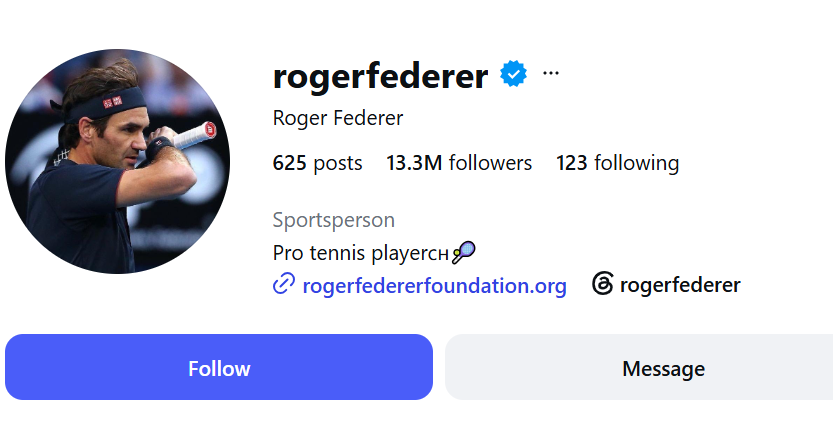
rogerfederer INSTAGRAM Profile
Roger Federer
625 posts
Sportsperson
Pro tennis player🇨🇭🎾
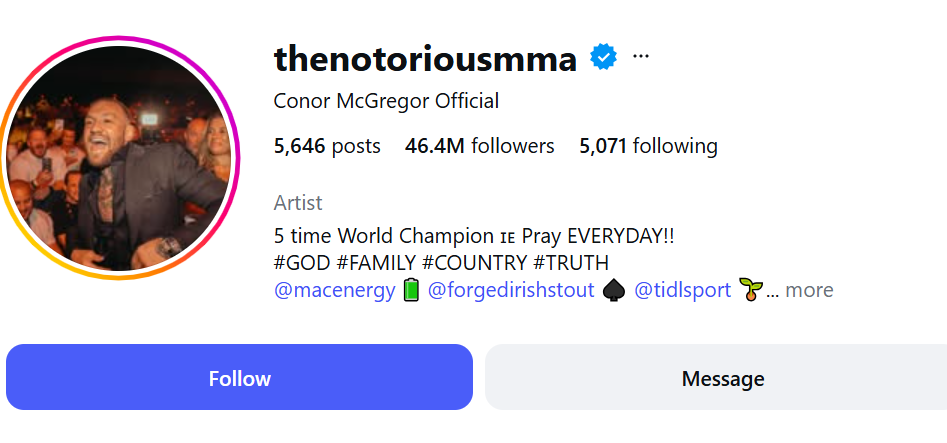
thenotoriousmma
Conor McGregor Official
5,646 posts
Artist
5 time World Champion 🇮🇪 Pray EVERYDAY!!
#GOD #FAMILY #COUNTRY #TRUTH
@macenergy 🔋 @forgedirishstout ♠️ @tidlsport 🌱…

2 thoughts on “Roger Federer and Conor McGregor: Sports Icons Compared”