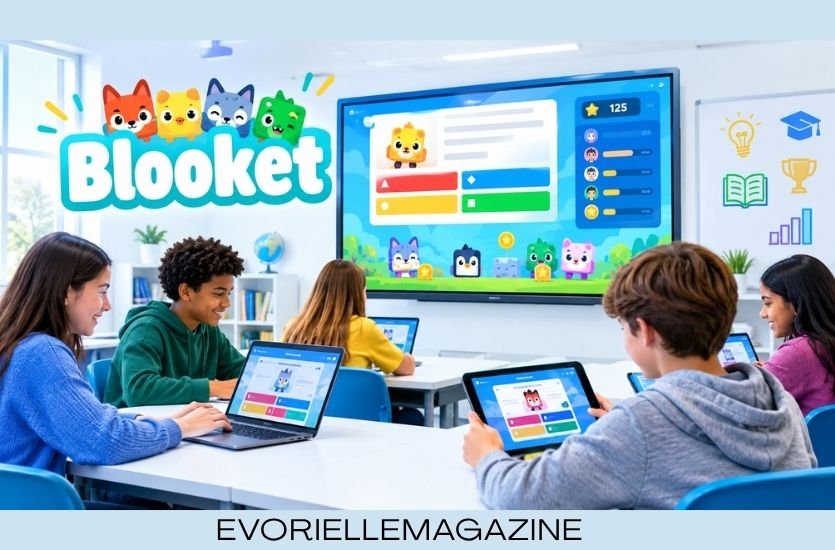
Blooket is a game-based learning platform that turns traditional question-and-answer activities into interactive educational games. Designed mainly for classroom review and practice, Blooket allows teachers to create or choose question sets, select different game modes, and invite students to participate through a web browser. Instead of simply answering a conventional quiz, students can answer questions while racing, collecting rewards, managing virtual resources, defending towers, or participating in other game experiences.
The platform has become popular because it combines learning content with familiar gaming elements. Teachers can use Blooket for vocabulary practice, mathematics review, science questions, history activities, test preparation, warm-ups, and quick knowledge checks. Students can participate in live classroom games or complete certain activities independently. The basic idea is simple: the teacher supplies the educational questions, while Blooket provides the interactive environment around them.
Quick Bio of Blooket
| Detail | Information |
|---|---|
| Name | Blooket |
| Type | Game-based learning platform |
| Main Purpose | Educational review and practice |
| Primary Users | Teachers and students |
| Platform | Web-based |
| Main Content | Question sets and interactive games |
| Virtual Characters | Blooks |
| Rewards | Tokens and XP |
| Main Activities | Live games, solo play, and homework |
| Pronunciation | Blue-kit |
| Common Uses | Classroom review, practice, and knowledge checks |
What Is Blooket?
Blooket is an online educational gaming platform that combines quiz questions with different interactive game formats. Its main purpose is to make review and practice more engaging by putting academic questions inside a game environment.
The platform follows a relatively simple process. A teacher can find a question set from the available library or create one specifically for a class. After selecting the questions, the teacher chooses a game mode and starts an activity. Students then join the activity and answer questions while participating in the selected game. Blooket describes this process as getting a question set, choosing a game mode, and then playing, learning, and analyzing the results.
This separation between questions and gameplay is one of Blooket’s defining characteristics. A teacher can use similar academic questions in different game modes, giving students a different experience without necessarily requiring a completely new lesson.
How Does Blooket Work?
Blooket begins with a question set. A question set can contain educational questions about practically any suitable subject. Teachers can prepare their own material or use existing sets created by other users.
After selecting the questions, the host chooses a game mode. Different modes introduce different objectives and mechanics. Some emphasize speed, while others include strategy, resources, collecting, competition, or chance.
Students then join the activity through the information provided by the host. During the game, they answer questions and their answers influence their progress. The exact effect of a correct answer depends on the selected game mode.
When the activity is finished, teachers can review available results. Blooket promotes its reporting tools as a way to help educators identify knowledge gaps and understand student performance.
This makes Blooket more than a simple quiz generator. It combines content creation, gameplay, student participation, and performance feedback in one system.
Blooket Game Modes
Game modes are one of the most important parts of Blooket. Instead of forcing every quiz to follow the same format, Blooket provides different environments in which students can answer the same or similar questions.
The available catalog changes over time as Blooket introduces new experiences and updates existing ones. Current Blooket activities include modes such as Classic, Gold Quest, Tower Defense, Café, Factory, Racing, Fishing Frenzy, Monster Brawl, Tower Defense 2, and Study, among others.
Classic
Classic provides a straightforward Blooket experience in which students answer questions while competing within the game. It can be useful when a teacher wants an easy-to-understand review activity without a particularly complicated gameplay system.
Gold Quest
Gold Quest adds virtual gold and additional game mechanics to the question-answering experience. Students answer questions while attempting to increase their resources and improve their position.
Because the mode incorporates gameplay elements beyond simple accuracy, the final game result should not automatically be interpreted as a direct academic ranking.
Tower Defense
Tower Defense combines educational questions with a strategy-based environment. Students answer questions and use their progress to build or improve defenses against incoming threats.
This format can make repeated review more engaging because students have an additional objective beyond simply completing questions.
Tower Defense 2
Tower Defense 2 builds on the tower-defense concept with an updated gameplay experience. Students continue answering questions while participating in a strategic environment involving defenses and progression.
Café
Café puts students into a virtual café environment. Question answering contributes to the student’s ability to manage the activity and progress through the game.
The mode illustrates how Blooket can place ordinary academic questions inside an environment that feels very different from a standard quiz.
Factory
Factory introduces a production and resource-management theme. Students answer questions while developing their virtual factory and working toward in-game progress.
Racing
Racing turns question answering into a race. Students attempt to move toward the finish while answering questions correctly.
Its straightforward concept can make it useful for quick review sessions when a teacher wants students to remain active and focused.
Fishing Frenzy
Fishing Frenzy adds a fishing-themed environment to question practice. Current Blooket materials include it among the solo game experiences available for certain assignments.
Monster Brawl
Monster Brawl combines question answering with a game environment involving monsters and progression. It gives students another way to interact with the same basic learning process.
Study
Study takes a more direct approach to independent practice. Instead of depending entirely on elaborate competitive mechanics, it provides an environment where students can concentrate on answering and reviewing questions.
What Are Blooks in Blooket?
Blooks are the collectible virtual characters associated with Blooket. They are an important part of the platform’s gaming identity and give students something to collect and personalize.
The Blook system makes Blooket feel different from an ordinary online quiz. Students are not only thinking about whether they answered a question correctly; they can also become interested in collecting characters and progressing within the platform.
However, Blooks are primarily an engagement and personalization feature. Having a particular Blook does not demonstrate academic achievement or subject mastery.
Blooket Tokens and XP
Blooket also uses Tokens and XP as part of its progression system. Students can earn these rewards through gameplay and use available features to develop their collections.
The reward system creates a longer-term motivation loop around gameplay. Instead of every activity ending when the final question is answered, students can continue building their virtual collection and tracking their progress.
This gamification is useful for understanding why Blooket can feel more like a game than a traditional quiz. The academic content remains the questions, while the Tokens, XP, Blooks, and game modes provide the surrounding motivation.
How to Join a Blooket Game
Joining a Blooket game is designed to be relatively simple. In a typical classroom activity, the teacher hosts the game and provides students with the required joining information.
Depending on the activity, students may use a game code, QR code, or joining link. This allows students to participate through a browser without requiring complicated software installation.
The simple joining process is especially useful in classrooms where a teacher needs to get an entire group into an activity quickly. Students can move from a lesson into a review game without spending a large amount of class time setting up individual accounts.
Searches such as “Blooket join,” “Blooket game code,” “Blooket join code,” and “how to join Blooket” are therefore closely connected to the platform’s main classroom use.
Blooket Homework
Blooket is not limited to live classroom games. Teachers can also use its homework system to provide students with activities that can be completed independently.
Current Blooket homework materials describe assignments that can be accessed through a QR code or link. Students can see information associated with the assignment and complete available solo game modes.
This makes Blooket useful beyond the classroom. A teacher can use a game during a lesson and then provide additional question practice as homework.
The homework system also demonstrates how Blooket can function as both a live classroom tool and an independent practice platform.
Blooket for Teachers
For teachers, Blooket can reduce some of the repetition involved in classroom review. A teacher can create a strong question set and then reuse that content in different game environments.
For example, a teacher teaching vocabulary could prepare a question set once and later use it for several review sessions. Changing the game mode can provide students with a different experience while keeping the academic content connected to the same learning objective.
Teachers can also search for existing question sets. This can reduce preparation time, although educators should always review user-created material before using it with students.
Blooket is particularly useful for short review sessions, warm-ups, vocabulary activities, factual recall, formative checks, and test preparation. Recent independent reviews also describe the platform as more appropriate for low-stakes review than for replacing deeper forms of teaching and assessment.
Blooket for Students
For students, Blooket changes the experience of answering questions by introducing interactive gameplay. Instead of completing a conventional quiz, students can answer questions while participating in a competitive or strategic environment.
The experience can be particularly engaging for students who enjoy games and friendly competition. Current user reviews on G2 frequently mention engagement, customization, and the ability to create classroom review activities as positive aspects of the platform.
However, students do not all respond to competition in the same way. Some enjoy leaderboards and fast-paced activities, while others may prefer independent or less competitive practice.
Teachers can therefore select game modes according to the needs of their particular class.
Is Blooket Free?
Blooket offers a free version with core features that allow teachers to create and discover question sets and host classroom activities. This makes it possible to experiment with Blooket without immediately purchasing a subscription.
The free version is useful for teachers who only need basic game-based review. However, Blooket also provides a paid option for educators who require additional features.
Recent coverage of Blooket Plus reports that premium features include expanded live-game capacity, more detailed reports, organizational tools, audio questions, and other additional functionality.
Because educational platforms can change their plans and features, current subscription information should always be checked before making a purchasing decision.
What Is Blooket Plus?
Blooket Plus is the paid version of the platform designed to provide additional capabilities for educators.
The difference between the free and paid experiences is mainly related to expanded teacher functionality. Recent information reports that Blooket Plus can support live games with up to 300 players and provides additional reporting and organizational features.
For teachers who use Blooket occasionally, the free version may provide enough functionality. Teachers who use the platform frequently or need additional reporting and classroom-management capabilities may have different requirements.
The decision to use Plus therefore depends on the teacher’s usage and the features needed rather than simply on the existence of additional features.
Is Blooket Good for Learning?
Blooket can be useful for learning, particularly when it is used for review and retrieval practice. It can give students repeated opportunities to recall information that has already been taught.
For example, a teacher can use Blooket to review vocabulary definitions, multiplication facts, scientific terms, historical information, geography facts, or concepts that students need to remember.
However, Blooket should not be treated as a complete teaching method. A game can make practice more engaging, but entertainment alone does not guarantee deeper understanding.
Recent independent educational analysis makes a similar distinction, describing Blooket as useful for energetic review and short knowledge checks while noting that it does not replace explanation, writing, discussion, or complex problem-solving.
The quality of the questions is also important. If questions are inaccurate or poorly designed, an engaging game will not solve the underlying educational problem.
Benefits of Blooket
One of Blooket’s main benefits is variety. Teachers can select from different game environments rather than using the same quiz format repeatedly.
Another benefit is engagement. Game mechanics can make routine review feel more interactive and can encourage students to participate.
Blooket can also reduce preparation time when teachers use existing question sets as a starting point. At the same time, teachers retain the ability to create their own questions when they want content that is specifically connected to their curriculum.
The platform’s reporting features provide another useful element. Teachers can review available results and use the information to identify topics that require further attention.
Finally, Blooket supports both live and independent activities, giving teachers more flexibility in how they use the platform.
Limitations of Blooket
Blooket also has limitations that teachers should understand.
The first is that game mechanics can sometimes become more memorable than the academic content. Students may focus heavily on winning, collecting rewards, or progressing through a game rather than thinking carefully about why an answer is correct.
Another issue is that some modes include elements such as speed, strategy, resources, or chance. Consequently, winning a game does not necessarily mean that the winning student has the strongest academic understanding.
Competition can also affect students differently. Some students find it motivating, while others may prefer quieter learning activities.
The quality of Blooket also depends heavily on the question set. Teachers should check questions and answers before using community-created material.
These limitations do not make Blooket unsuitable for education. Instead, they show why the platform works best when the teacher chooses an appropriate game mode and connects the activity to a clear learning objective.
Blooket vs. Kahoot
Blooket and Kahoot are both widely associated with interactive educational quizzes, but their approaches are different.
Kahoot is strongly recognized for its quiz-show style of gameplay, while Blooket puts greater emphasis on multiple game environments, collectibles, and different gameplay mechanics.
Blooket can therefore be useful when a teacher wants students to experience the same question set through different types of games.
The important factor is the learning objective. Teachers can choose the platform and activity format that best fits their classroom rather than assuming that one educational gaming platform is suitable for every situation.
Blooket vs. Quizizz
Blooket is also frequently compared with Quizizz and other digital learning platforms.
Blooket’s identity is strongly connected to game modes, Blooks, rewards, and competitive gameplay. Other quiz platforms may place greater emphasis on assessment, assignments, independent practice, or detailed quiz functionality.
The distinction means that teachers should consider what they want students to do during the activity. If the goal is highly game-based review, Blooket’s design may be particularly relevant. If the goal is a different form of assessment or independent practice, another platform may offer features that better match that purpose.
Who Can Use Blooket?
Blooket is primarily designed for educators and students, with the official platform describing its gameplay as suitable from early elementary school through high school and beyond.
Teachers can use it for classroom review, vocabulary, factual recall, warm-ups, formative activities, and homework.
Students can use it during live classroom sessions or through available independent activities.
The platform may also have applications outside traditional classrooms when the activity involves question-based practice, although its strongest identity remains educational.
Tips for Using Blooket Effectively
The most important step is to choose questions that match the learning objective. A visually impressive game cannot compensate for weak educational content.
Teachers should also select a game mode that fits the purpose of the lesson. A fast competitive mode may work well for a short review, while a quieter activity may be more appropriate when students need to concentrate on difficult material.
It is also useful to discuss mistakes after the game. If students simply see whether they were right or wrong and immediately move on, some learning opportunities can be lost. Reviewing difficult questions afterward can turn gameplay into a more meaningful learning experience.
Teachers should also avoid using Blooket for every lesson. Variety in teaching methods is important, and students can benefit from discussions, writing, projects, experiments, problem-solving, reading, and other forms of learning alongside digital games.
Final Thoughts
Blooket has become a recognizable name in game-based education by combining traditional question sets with interactive gameplay. Instead of limiting students to a standard digital quiz, the platform gives teachers different ways to place educational questions inside competitive, strategic, and progression-based activities.
Its main strengths are variety, accessibility, reusable question sets, student engagement, and flexible gameplay. Blooks, Tokens, XP, game modes, live sessions, solo activities, homework, and reporting all contribute to the platform’s broader learning experience.
At the same time, Blooket works best when it supports a lesson rather than becoming the entire lesson. Game mechanics can encourage participation, but they do not replace good questions, clear explanations, discussion, or deeper assessment.
For teachers looking for an interactive way to review previously taught material, Blooket provides a flexible option. For students, it can transform routine question practice into an experience that feels more like a game. Its educational value ultimately depends on how thoughtfully the platform is used, how strong the questions are, and whether the activity supports the teacher’s broader learning goals.
READ MORE ABOUT : Aretha Franklin and Kathy Warden
READ MORE ABOUT : Research Dossier for Target Company

One thought on “Blooket: Game-Based Learning Platform for Students and Teachers”