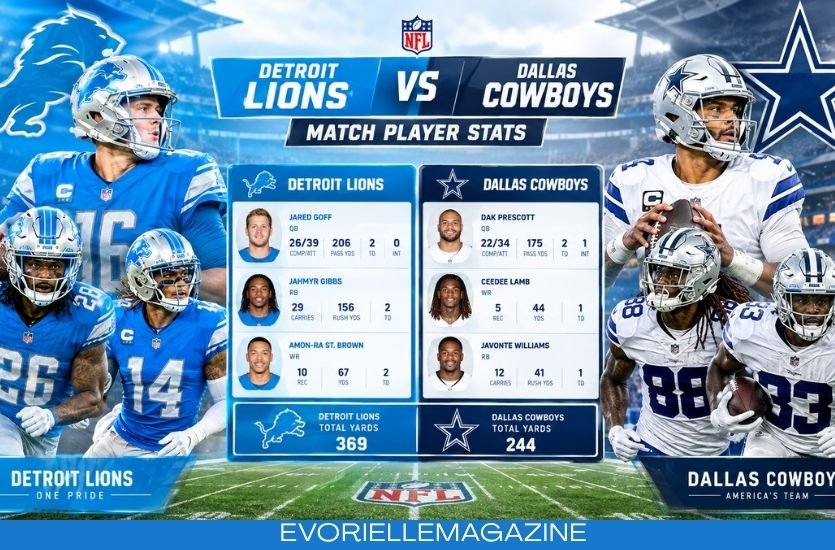
The Detroit Lions vs Dallas Cowboys match player stats from the December 4, 2025 NFL regular-season meeting provide a detailed look at one of the highest-scoring games of the season. Played at Ford Field in Detroit, the matchup ended with the Lions defeating the Cowboys 44–30. The game featured productive quarterback play, explosive rushing performances, big receiving numbers, long-range field goals and a major turnover difference that helped shape the final result.
Although Dallas finished the game with more total offensive yards, Detroit was more efficient in turning important opportunities into points. The Lions also avoided turnovers, while Dallas committed three. That difference became one of the most important statistical factors in the game.
Quick Match Bio
| Category | Details |
|---|---|
| Match | Detroit Lions vs Dallas Cowboys |
| League | National Football League |
| Match Date | December 4, 2025 |
| Venue | Ford Field, Detroit |
| Match Type | Regular Season |
| Final Score | Detroit Lions 44, Dallas Cowboys 30 |
| Lions Quarterback | Jared Goff |
| Cowboys Quarterback | Dak Prescott |
| Lions Rushing Leader | David Montgomery |
| Lions Touchdown Leader | Jahmyr Gibbs |
| Cowboys Passing Leader | Dak Prescott |
| Cowboys Receiving Leader | CeeDee Lamb |
| Cowboys Receiving Touchdown | Ryan Flournoy |
Detroit Lions vs Dallas Cowboys Match Overview
The December 4, 2025 meeting between Detroit and Dallas developed into a fast-paced offensive contest. Detroit scored 44 points while Dallas finished with 30. The Lions built their advantage through a combination of rushing touchdowns, efficient passing and effective red-zone execution.
Detroit’s victory was particularly notable because Dallas actually produced slightly more total yardage. The Cowboys finished with 417 total yards compared with 408 for Detroit. Dallas also ran 76 offensive plays, while Detroit ran 57. However, the Lions produced more points from their opportunities and protected the football throughout the game.
The turnover margin was one of the clearest differences. Dallas committed three turnovers while Detroit finished with none. That allowed Detroit to maintain control even when Dallas moved the ball successfully. The game demonstrated why box-score analysis requires more than simply looking at passing yards or total offensive production.
Jared Goff’s Passing Performance
Jared Goff played an important role in Detroit’s offensive performance. He completed 25 of 34 pass attempts for 309 yards and one touchdown without throwing an interception. His completion rate was approximately 73.5 percent, showing a high level of passing efficiency.
Goff’s performance was not based on an extremely high number of attempts. Detroit ran considerably fewer offensive plays than Dallas, yet Goff consistently moved the football when the Lions went to the air. His 309 passing yards represented a substantial portion of Detroit’s 408 total yards.
The most important aspect of Goff’s performance was his ball security. While Dallas quarterback Dak Prescott produced more passing yards, Goff avoided the turnovers that affected the Cowboys’ offense. That contrast is particularly important when examining the Detroit Lions vs Dallas Cowboys match player stats because it shows the difference between raw production and situational efficiency.
Goff also benefited from a balanced offensive approach. Detroit did not need to rely exclusively on the passing game because Jahmyr Gibbs and David Montgomery provided major contributions on the ground. That balance made it more difficult for Dallas to focus entirely on stopping the passing attack.
Dak Prescott’s Passing Statistics
Dak Prescott produced one of the biggest passing totals in the matchup. He completed 31 of 47 attempts for 376 yards and one touchdown. His passing yardage exceeded Goff’s total by 67 yards, and he attempted 13 more passes.
Prescott’s production helped Dallas reach 417 total yards, but the Cowboys were unable to convert their offensive volume into enough touchdowns. The biggest issue was turnovers. Prescott threw two interceptions, and Dallas finished the game with three turnovers overall.
The Cowboys’ quarterback therefore had a statistically productive passing night while also experiencing some costly mistakes. This combination makes Prescott’s performance one of the more interesting parts of the Detroit Lions vs Dallas Cowboys match player stats.
Dallas continued to move the ball through the air late in the game. Ryan Flournoy caught a 42-yard touchdown pass from Prescott in the fourth quarter, temporarily giving the Cowboys another opportunity to close the gap. However, Detroit responded with additional scoring plays and ultimately maintained its advantage.
Jahmyr Gibbs Becomes a Major Factor
Jahmyr Gibbs was one of the most important individual players in the game. He finished with 12 rushing attempts for 43 yards and three rushing touchdowns. He also contributed seven receptions for 77 yards.
The three rushing touchdowns were especially significant because they came at different stages of the game and helped Detroit repeatedly answer Dallas’s scoring attempts. Gibbs scored from one yard in the first quarter, then added two more rushing touchdowns in the fourth quarter.
His final-quarter production was particularly important. Dallas attempted to remain within reach after Prescott connected with Flournoy for a 42-yard touchdown, but Gibbs responded with touchdown runs that helped Detroit restore its advantage.
Gibbs’ contribution also demonstrates why a player’s impact cannot always be measured through rushing yardage alone. His 43 rushing yards were not an enormous total by NFL standards, but three rushing touchdowns and 77 receiving yards made him one of the game’s most influential offensive players.
David Montgomery’s Impact on the Ground
David Montgomery provided another important component of Detroit’s rushing attack. He recorded six carries for 60 yards and one touchdown. His average of 10 yards per carry reflected the explosive nature of his contribution.
Montgomery’s biggest play was a 35-yard rushing touchdown in the second quarter. The play helped Detroit extend its lead and demonstrated the effectiveness of the Lions’ rushing attack against the Cowboys’ defense.
Together, Montgomery and Gibbs gave Detroit multiple rushing threats. Gibbs supplied the touchdown production, while Montgomery delivered efficient yardage on a smaller number of attempts.
This combination helped Detroit remain balanced throughout the game. The Lions did not need Goff to throw the ball on every possession because their running backs could create significant gains and finish drives.
CeeDee Lamb Leads the Cowboys in Receiving
CeeDee Lamb was Dallas’s leading receiver in the matchup. He finished with six receptions for 121 yards, averaging more than 20 yards per catch.
Lamb’s 121 receiving yards represented one of the Cowboys’ biggest offensive highlights. His ability to generate substantial gains helped Dallas maintain offensive pressure and contributed to Prescott’s 376 passing yards.
The Cowboys also received an important performance from Ryan Flournoy. Flournoy caught nine passes for 115 yards and a touchdown. His 42-yard touchdown reception in the fourth quarter became one of the game’s major late moments.
Jake Ferguson also contributed five receptions for 58 yards. The distribution of receiving production shows that Dallas was able to generate contributions from multiple players rather than depending entirely on one target.
Detroit’s Receiving Performance
Detroit’s passing attack featured several productive receivers. Jameson Williams led the Lions with seven receptions for 96 yards, while Amon-Ra St. Brown recorded six receptions for 92 yards.
Williams averaged approximately 13.7 yards per reception, giving Detroit an important downfield option. St. Brown averaged more than 15 yards per catch, providing another efficient target for Goff.
Gibbs also played a major role as a receiver, adding seven catches for 77 yards. His receiving production combined with his three rushing touchdowns made him a major dual-threat contributor.
The distribution of Detroit’s receiving statistics illustrates how the Lions created opportunities across multiple offensive players. Dallas could not simply focus on one receiver because Detroit had several players capable of producing meaningful gains.
Detroit Lions Rushing Attack
The Lions’ rushing attack was one of the defining elements of the matchup. Detroit finished with 22 rushing attempts, and Montgomery and Gibbs supplied the majority of the team’s most important plays.
While the Cowboys recorded more total offensive yards, Detroit’s rushing touchdowns were especially valuable. The Lions scored four rushing touchdowns in the game, with Gibbs accounting for three and Montgomery contributing one.
The ability to finish drives on the ground was an important reason Detroit scored 44 points. Rather than settling for field goals every time they reached scoring territory, the Lions repeatedly converted opportunities into touchdowns.
This efficiency helped compensate for the fact that Detroit had fewer offensive plays than Dallas. It is another reason the Detroit Lions vs Dallas Cowboys match player stats should be evaluated through both volume and efficiency.
Dallas Cowboys Rushing Performance
Dallas relied heavily on its passing game, but Javonte Williams led the Cowboys in rushing. He recorded 17 carries for 67 yards and one touchdown.
Prescott also contributed three rushing attempts for 14 yards. Malik Davis had three carries for six yards.
Dallas therefore had a relatively modest rushing contribution compared with its passing output. The Cowboys’ offense produced 417 total yards, but a large portion of that production came through Prescott’s arm.
The contrast between the two teams was noticeable. Detroit received significant touchdown production from its running backs, while Dallas relied more heavily on passing production and field goals to stay competitive.
Brandon Aubrey’s Long-Range Kicking
Brandon Aubrey provided Dallas with an important scoring contribution. He successfully converted field goals from 57, 42, 55 and 63 yards during the game.
The 63-yard field goal was particularly notable because it demonstrated Aubrey’s exceptional range. His long-distance kicking kept Dallas on the scoreboard during periods when the Cowboys struggled to finish drives with touchdowns.
Field goals, however, could not completely compensate for the difference in touchdown production. Detroit repeatedly reached the end zone, particularly through its rushing attack, while Dallas had to rely on a mixture of field goals and touchdowns.
Aubrey’s performance nevertheless stands as one of the strongest individual special-teams contributions in the matchup.
Detroit Lions Special Teams
Detroit also received important contributions from kicker Jake Bates. Bates converted multiple field-goal attempts and extra points during the contest.
Special teams became especially important because the game featured repeated scoring possessions. Every successful kick helped maintain the scoring pace and prevented either team from losing contact with the opponent.
However, the biggest statistical difference remained offensive efficiency and turnovers rather than kicking alone. Detroit’s ability to combine successful field-goal attempts with multiple touchdowns allowed the Lions to reach 44 points.
Defensive Impact and Turnovers
The defensive statistics are essential when analyzing the Detroit Lions vs Dallas Cowboys match player stats. Although both offenses accumulated more than 400 total yards, Detroit’s defense created the more favorable turnover situation.
Dallas committed three turnovers while Detroit committed none. Prescott’s two interceptions were particularly important because interceptions can immediately end promising offensive drives and potentially create favorable field position for the opposing team.
Detroit’s defense therefore did not need to completely shut down Dallas’s offense. Instead, preventing Dallas from turning its yardage into consistent touchdowns and creating turnovers gave the Lions opportunities to build their lead.
Dallas’s defense faced the opposite challenge. The Cowboys had to deal with a Detroit offense that could pass effectively while also producing multiple rushing touchdowns.
Team Statistics Tell a Bigger Story
The team statistics reveal why the final score was more decisive than the yardage totals might initially suggest.
Dallas finished with 417 total yards, while Detroit had 408. Dallas also had the ball for 31:23 compared with Detroit’s 28:37. These numbers show that the Cowboys were capable of moving the football.
However, Detroit’s ability to avoid turnovers and finish drives was critical. Dallas generated 76 offensive plays compared with Detroit’s 57, yet Detroit scored 44 points.
This difference illustrates the importance of efficiency. More plays and more yards do not automatically produce a victory. Teams must also protect possession, convert scoring opportunities and finish drives.
The Lions’ four rushing touchdowns were particularly significant because touchdowns provide a much greater scoring return than field goals. Dallas moved the ball but often had to settle for kicking points, while Detroit repeatedly found the end zone.
Quarter-by-Quarter Scoring
The scoring pattern also explains how the game developed.
Detroit scored 10 points in the first quarter, while Dallas scored three. In the second quarter, Detroit added another 10 points and Dallas scored six. The Lions therefore entered halftime with a meaningful advantage.
Dallas responded with 10 points in the third quarter while Detroit scored seven, creating a more competitive second half. The Cowboys then scored 11 points in the fourth quarter, but Detroit produced 17 points in the final period.
The fourth quarter ultimately became decisive. Gibbs scored twice on the ground, while Dallas received a touchdown from Flournoy and additional points from Aubrey. Detroit’s late scoring prevented Dallas from turning its comeback attempt into a genuine reversal.
Why the Match Player Stats Matter
The value of the Detroit Lions vs Dallas Cowboys match player stats goes beyond identifying who gained the most yards. The numbers help explain how the game actually unfolded.
Goff demonstrated efficiency and ball security. Prescott demonstrated high-volume passing production but also experienced turnover problems. Gibbs combined rushing touchdowns with receiving yardage. Montgomery produced an explosive rushing touchdown. Lamb and Flournoy gave Dallas major receiving contributions, while Aubrey delivered several long-distance field goals.
Taken together, these statistics provide a more complete picture than the final score alone.
The matchup also demonstrates how different offensive approaches can produce different results. Dallas generated more total yards and ran more plays, but Detroit scored more touchdowns and committed no turnovers.
Historical Context of Lions vs Cowboys
Detroit and Dallas have a long history of regular-season meetings, making their matchups interesting from both a statistical and historical perspective. Previous meetings have included several high-scoring games, and the December 2025 contest added another notable result to the series.
The 2025 matchup was particularly memorable because both offenses produced more than 400 total yards. Yet Detroit’s 44-point performance ultimately separated the teams on the scoreboard.
For fans researching the rivalry, it is important to distinguish the December 2025 game from earlier meetings. For example, Detroit and Dallas also met during the 2024 regular season, but that was a separate game with a completely different statistical outcome.
Detroit Lions vs Dallas Cowboys Match Player Stats: Key Takeaways
The central statistical story is the contrast between yardage and efficiency. Dallas finished with more total yards, but Detroit scored 14 more points.
Goff completed 25 of 34 passes for 309 yards, one touchdown and no interceptions. Prescott completed 31 of 47 passes for 376 yards, one touchdown and two interceptions.
Gibbs was one of Detroit’s biggest stars with three rushing touchdowns and 77 receiving yards. Montgomery added 60 rushing yards and a touchdown. On the Dallas side, Lamb recorded 121 receiving yards, while Flournoy produced 115 receiving yards and a touchdown.
The turnover margin also stands out. Detroit finished without a turnover, while Dallas committed three. That difference helped Detroit convert its offensive opportunities into a 44-point performance.
Final Thoughts
The Detroit Lions vs Dallas Cowboys match player stats from December 4, 2025, tell the story of a game in which Detroit combined efficient quarterback play, explosive rushing production and strong ball security to defeat Dallas 44–30.
Dak Prescott’s 376 passing yards and CeeDee Lamb’s 121 receiving yards showed that Dallas could move the football effectively. Brandon Aubrey’s long-range kicking added another important element to the Cowboys’ attack. However, Dallas’s three turnovers and comparatively limited touchdown production prevented its yardage advantage from translating into enough points.
For Detroit, Jared Goff provided efficient passing without an interception, while Jahmyr Gibbs delivered three rushing touchdowns and significant receiving production. David Montgomery added a 60-yard rushing performance and a touchdown, while Jameson Williams and Amon-Ra St. Brown each surpassed 90 receiving yards.
Ultimately, the statistics show that the game was not simply decided by which team gained more yards. Detroit was more effective at protecting the football and finishing scoring opportunities. That combination helped the Lions turn 408 total yards into 44 points and secure a 14-point victory over the Cowboys.
Frequently Asked Questions
What was the final score between the Detroit Lions and Dallas Cowboys?
The Detroit Lions defeated the Dallas Cowboys 44–30 in their December 4, 2025 regular-season matchup at Ford Field.
How many passing yards did Jared Goff have?
Jared Goff completed 25 of 34 passes for 309 yards and one touchdown without an interception.
How many passing yards did Dak Prescott have?
Dak Prescott completed 31 of 47 passes for 376 yards and one touchdown. He also threw two interceptions.
Who scored the most rushing touchdowns?
Detroit running back Jahmyr Gibbs scored three rushing touchdowns, the most by any player in the game.
How many receiving yards did CeeDee Lamb record?
CeeDee Lamb recorded six receptions for 121 yards for the Dallas Cowboys.
How many receiving yards did Ryan Flournoy have?
Ryan Flournoy caught nine passes for 115 yards and scored one touchdown for Dallas.
Which team had more total yards?
Dallas finished with 417 total yards, while Detroit recorded 408 total yards.
How many turnovers did each team commit?
Detroit committed zero turnovers, while Dallas committed three.
Why did Detroit win despite having fewer total yards?
Detroit was more efficient with its opportunities, scored four rushing touchdowns and avoided turnovers. Dallas generated more yardage but committed three turnovers and had to rely more heavily on field goals.
When was this Lions vs Cowboys matchup played?
The game was played on December 4, 2025, at Ford Field in Detroit.
READ MORE ABOUT : Los Angeles Chargers vs Las Vegas Raiders Match Player Stats
READ MORE ABOUT : Chargers vs Miami Dolphins Match Player Stats
