When people search for HCOOCH CH2 H2O, they are often looking for an explanation of a confusing chemistry expression involving an organic ester, water, and possible carbon-containing fragments. At first glance, the phrase looks like a chemical formula, but it does not represent one clearly defined and standard compound in the way formulas such as H₂O or CO₂ do.
The expression is better understood by separating its components and examining the chemistry that may be intended. The most useful interpretation connects the term with methyl formate, written correctly as HCOOCH₃, and its reaction with water. This reaction is an example of ester hydrolysis and produces formic acid and methanol under suitable conditions.
Understanding HCOOCH CH2 H2O therefore requires more than simply memorizing letters and numbers. It requires looking at chemical structure, molecular formulas, functional groups, hydrolysis, and the role of water in organic reactions.
Quick Chemistry Facts
| Property | Information |
|---|---|
| Search term | HCOOCH CH2 H2O |
| Standard single compound? | No, not as written |
| Closely related compound | Methyl formate |
| Correct methyl formate formula | HCOOCH₃ |
| Molecular formula | C₂H₄O₂ |
| Chemical class | Ester |
| Water formula | H₂O |
| Main reaction discussed | Ester hydrolysis |
| Hydrolysis products | Formic acid and methanol |
| Formic acid formula | HCOOH |
| Methanol formula | CH₃OH |
What Does HCOOCH CH2 H2O Mean?
The expression HCOOCH CH2 H2O is an incomplete or ambiguous chemical notation rather than the established name of a single molecule. Several online articles use the phrase as shorthand for chemistry involving methyl formate and water, particularly the hydrolysis of an ester.
The important correction is that methyl formate is normally written as HCOOCH₃, not simply HCOOCH. The subscript 3 identifies the three hydrogen atoms attached to the methyl group.
Methyl formate can also be written using its systematic name, methyl methanoate. Its molecular formula is C₂H₄O₂, and its structure contains an ester functional group.
The separate CH₂ portion of the search phrase should also be treated cautiously. CH₂ commonly represents a methylene group within an organic structure, but simply writing CH₂ does not tell us what molecule it belongs to. It can occur in many different organic compounds and reaction intermediates.
For this reason, it would be inaccurate to describe HCOOCH CH2 H2O as one isolated chemical substance.
Understanding HCOOCH₃: Methyl Formate
To understand the chemistry behind the search term, the first important compound to recognize is methyl formate.
Methyl formate is a simple ester derived conceptually from formic acid and methanol. Its condensed structural formula is:
HCOOCH₃
Its molecular formula is:
C₂H₄O₂
The molecule contains a carbonyl group and an oxygen atom connecting the carbonyl-containing portion to a methyl group. This arrangement gives methyl formate its characteristic ester functional group.
The structural representation can be simplified as:
H–C(=O)–O–CH₃
The part containing C=O is the carbonyl portion, while the oxygen connected to CH₃ forms the ester linkage.
Methyl formate is a volatile organic compound and is classified chemically as a formate ester. Its relatively low boiling point also makes it significantly more volatile than many other organic liquids.
Why the Formula Is Often Written Incorrectly
One reason the keyword HCOOCH CH2 H2O can be confusing is that chemical formulas are sometimes copied, typed, or searched without proper subscripts.
For example, HCOOCH₃ can become HCOOCH3, and in less precise online writing it may be shortened further to HCOOCH.
Similarly, H₂O is frequently typed as H2O, while CH₂ becomes CH2.
Search engines preserve these variations, so a person searching for a reaction may enter an incomplete or incorrectly formatted version and still find articles discussing the intended chemistry.
However, accurate scientific writing should restore the proper formulas whenever possible.
The Role of CH₂
The CH₂ part deserves special attention because it does not automatically mean that a separate CH₂ molecule is participating in the methyl formate hydrolysis reaction.
In organic chemistry, CH₂ generally represents a methylene group. A methylene group consists of one carbon atom bonded to two hydrogen atoms and is normally connected to other atoms or groups.
For example, a structural chain can contain:
–CH₂–CH₂–
Here, each CH₂ unit is part of a larger molecule.
CH₂ can also appear in more reactive chemical species under particular conditions. Therefore, its meaning depends entirely on the surrounding molecular structure.
For the basic methyl formate hydrolysis reaction, CH₂ does not need to be inserted into the balanced equation. The properly written reaction is based on methyl formate and water:
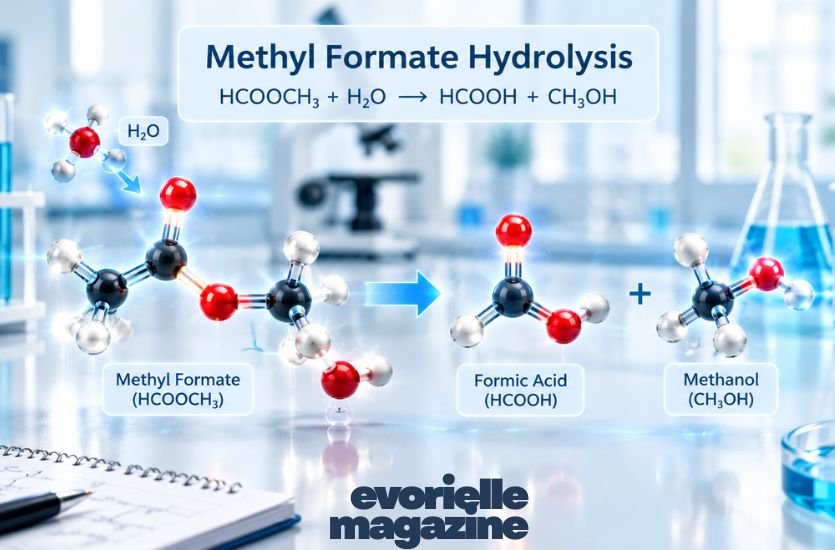
HCOOCH₃ + H₂O ⇌ HCOOH + CH₃OH
This distinction is important because some online explanations incorrectly make CH₂ appear to be an independent reactant in this reaction.
The Main HCOOCH CH2 H2O Reaction
The most useful reaction associated with this search term is the hydrolysis of methyl formate.
The balanced reaction is:
HCOOCH₃ + H₂O ⇌ HCOOH + CH₃OH
In simple words, methyl formate reacts with water to form formic acid and methanol.
Here, HCOOCH₃ represents methyl formate, H₂O represents water, HCOOH represents formic acid, and CH₃OH represents methanol.
This is an example of ester hydrolysis. The term hydrolysis refers broadly to a chemical process in which water participates in breaking chemical bonds.
The reaction can be reversible, which is why a reversible arrow is useful when discussing the equilibrium reaction. Scientific literature on methyl-formate hydrolysis describes this reversible behavior.
What Is Ester Hydrolysis?
Esters are a major family of organic compounds. They contain the characteristic structure associated with a carboxylic acid derivative and an organic group attached through oxygen.
When an ester undergoes hydrolysis, water participates in breaking the ester linkage. Depending on the conditions, the reaction can produce a carboxylic acid and an alcohol.
For methyl formate, the general transformation is particularly simple:
Ester + Water → Carboxylic Acid + Alcohol
In this specific case:
Methyl formate + Water → Formic acid + Methanol
Therefore:
HCOOCH₃ + H₂O ⇌ HCOOH + CH₃OH
This makes methyl formate a useful example for students learning how ester hydrolysis works.
How Methyl Formate Hydrolysis Happens
The detailed mechanism depends on whether the reaction is acid-catalyzed, base-catalyzed, or proceeding through another catalytic pathway.
In an acid-catalyzed mechanism, the carbonyl portion of the ester can become more susceptible to attack. Water can then participate in the reaction at the carbonyl carbon, producing an intermediate structure.
After several proton-transfer and bond-rearrangement steps, the ester linkage is ultimately broken and the products form.
The simplified result is formic acid and methanol.
The mechanism is more complicated than the final equation makes it appear. Chemical equations show the starting materials and products, but they do not necessarily show every intermediate formed during the reaction.
Acid-Catalyzed Hydrolysis
Acid can act as a catalyst in ester hydrolysis.
A catalyst changes the reaction pathway and can increase the reaction rate without being consumed overall in the reaction.
Under acidic conditions, protonation of the ester can make the carbonyl carbon more susceptible to nucleophilic attack by water. Further proton-transfer steps eventually allow the ester bond to be cleaved.
The exact mechanism involves several stages, but the overall reaction remains:
HCOOCH₃ + H₂O ⇌ HCOOH + CH₃OH
This type of reaction is an important example in organic chemistry because it demonstrates how catalysts can influence molecular transformations.
Base-Catalyzed Hydrolysis
Esters can also undergo hydrolysis under basic conditions. Base-promoted ester hydrolysis is often called saponification, although the term is most commonly associated with the hydrolysis of fats and oils to produce soap.
For methyl formate, basic conditions can lead toward formate-containing products and methanol. The exact chemical form of the product depends on the conditions and whether the medium is acidic or basic.
This illustrates an important chemistry principle: the same starting compound can produce differently represented products depending on the reaction environment.
Why Water Is Important
Water is much more than a background solvent in this reaction.
In hydrolysis, water provides atoms that become incorporated into the products. Its participation helps convert the ester into the corresponding acid and alcohol.
In the methyl formate system, the oxygen and hydrogen atoms supplied through the reaction ultimately contribute to the formation of formic acid and methanol.
This is why H₂O appears on the reactant side of the hydrolysis equation.
Water participates in countless chemical reactions, including hydrolysis reactions involving esters, amides, carbohydrates, and other compounds.
Products of the Reaction
The two main products associated with methyl formate hydrolysis are formic acid and methanol.
Formic acid has the formula HCOOH and is also known as methanoic acid. It is the simplest carboxylic acid.
Methanol has the formula CH₃OH and is the simplest alcohol.
The relationship between the reactants and products can therefore be summarized as:
Methyl formate + water = formic acid + methanol
Or chemically:
HCOOCH₃ + H₂O ⇌ HCOOH + CH₃OH
This reaction is a straightforward example of how an ester can be converted into a carboxylic acid and an alcohol.
The Reverse Reaction
The chemistry can also be viewed in the opposite direction.
Formic acid and methanol can react to form methyl formate and water under appropriate esterification conditions:
HCOOH + CH₃OH ⇌ HCOOCH₃ + H₂O
This is called esterification.
Hydrolysis and esterification are therefore closely related processes. One direction forms the ester, while the other breaks it apart.
The reversible nature of these reactions means that reaction conditions and equilibrium are important when determining which side is favored.
Physical Properties of Methyl Formate
Methyl formate is a colorless and highly volatile liquid. Its molecular weight is approximately 60.05 g/mol.
Its relatively low boiling point means that it evaporates readily compared with many less volatile organic compounds.
Methyl formate is also flammable, so it should be handled using appropriate laboratory and industrial safety procedures.
These physical properties are relevant because they influence how the substance is stored, transported, processed, and used.
Uses of Methyl Formate
Methyl formate has been used in several areas of chemical manufacturing and industrial chemistry. Its properties make it useful as a chemical intermediate and in solvent-related applications.
The compound has also been investigated and used in processes involving the manufacture of other chemicals.
Its chemistry is particularly interesting because methyl formate can serve as a relatively simple model ester for studying reactions involving carbonyl compounds.
However, industrial applications should not be confused with household uses. Methyl formate is a chemical substance requiring appropriate handling and should not be treated as an ordinary consumer liquid.
Importance in Organic Chemistry
The chemistry associated with HCOOCH CH2 H2O is useful because it demonstrates several fundamental concepts at once.
Students can learn how molecular formulas differ from structural formulas, how functional groups determine chemical behavior, how esters undergo hydrolysis, and how water can participate directly in chemical reactions.
The example also shows why precise chemical notation matters.
A missing subscript can completely change how a formula is interpreted. Writing HCOOCH instead of HCOOCH₃ may make a chemical expression ambiguous or misleading.
For this reason, chemical formulas should always be written as accurately as possible.
Common Misunderstandings About HCOOCH CH2 H2O
One common misunderstanding is that HCOOCH CH2 H2O is the official molecular formula of a single chemical compound. It is not a standard complete formula for one clearly defined molecule.
Another misunderstanding is that CH₂ must always be a separate reactant. In organic chemistry, CH₂ is usually a structural unit whose meaning depends on the molecule in which it occurs.
It is also incorrect to write methyl formate simply as HCOOCH when discussing its complete molecular structure. The conventional condensed formula is HCOOCH₃.
Another mistake is to assume that adding water automatically causes an ester to hydrolyze instantly. Reaction rate depends on factors such as temperature, catalysts, concentrations, solvent conditions, and the chemical environment.
Why Accurate Chemical Notation Matters
Chemistry depends heavily on precision. A formula is not merely a collection of letters and numbers. The position and number of atoms communicate the molecular structure.
For example, H₂O clearly represents water, while HCOOCH₃ identifies a particular ester structure.
When subscripts are removed, formulas can become ambiguous. This is especially important for students, researchers, writers, and anyone preparing educational content.
Therefore, when discussing the keyword HCOOCH CH2 H2O, the best approach is to explain its ambiguity rather than presenting it as a scientifically established compound name.
Frequently Asked Questions
Is HCOOCH CH2 H2O a chemical compound?
No. As written, HCOOCH CH2 H2O is not a standard complete molecular formula identifying one specific compound. It is better treated as an ambiguous chemistry search expression.
What compound is most closely related to HCOOCH?
The most relevant compound is methyl formate, whose correct condensed formula is HCOOCH₃.
What happens when methyl formate reacts with water?
Methyl formate can undergo hydrolysis with water to produce formic acid and methanol under suitable conditions.
What is the balanced reaction?
The reaction is:
HCOOCH₃ + H₂O ⇌ HCOOH + CH₃OH
What does CH₂ mean?
CH₂ commonly represents a methylene group within an organic molecule. Its exact chemical role depends on the surrounding molecular structure.
Is HCOOCH₃ an ester?
Yes. Methyl formate is an ester and is also called methyl methanoate.
What are the products of methyl formate hydrolysis?
The principal products are formic acid and methanol.
Is the reaction reversible?
Under suitable conditions, methyl formate hydrolysis can be reversible, establishing an equilibrium between the ester and the hydrolysis products.
Why is H₂O included in the reaction?
Water participates in the hydrolysis process and supplies atoms involved in converting the ester into the acid and alcohol products.
Conclusion
HCOOCH CH2 H2O is best understood as an ambiguous chemistry expression rather than the name or complete formula of a single compound. The most useful interpretation connects the keyword with methyl formate, HCOOCH₃, water, and ester hydrolysis.
The central reaction is:
HCOOCH₃ + H₂O ⇌ HCOOH + CH₃OH
This reaction demonstrates how methyl formate can undergo hydrolysis to produce formic acid and methanol. It also provides a useful introduction to ester chemistry, molecular structures, reaction mechanisms, catalysts, equilibrium, and the importance of accurate chemical notation. Online articles targeting this keyword commonly describe the same hydrolysis concept, although the exact phrase itself should not be presented as a formally established molecular formula.
For anyone searching HCOOCH CH2 H2O, the key lesson is simple: look beyond the unusual wording and identify the actual chemical structures involved. Once HCOOCH₃ is recognized as methyl formate and H₂O as water, the central chemistry becomes much easier to understand.
READ MORE ABOUT : New York Jets vs New England Patriots Match Player Stats
READ MORE ABOUT : 444 Meaning

One thought on “HCOOCH CH2 H2O: Meaning, Reaction, Formula, and Chemistry Explained”