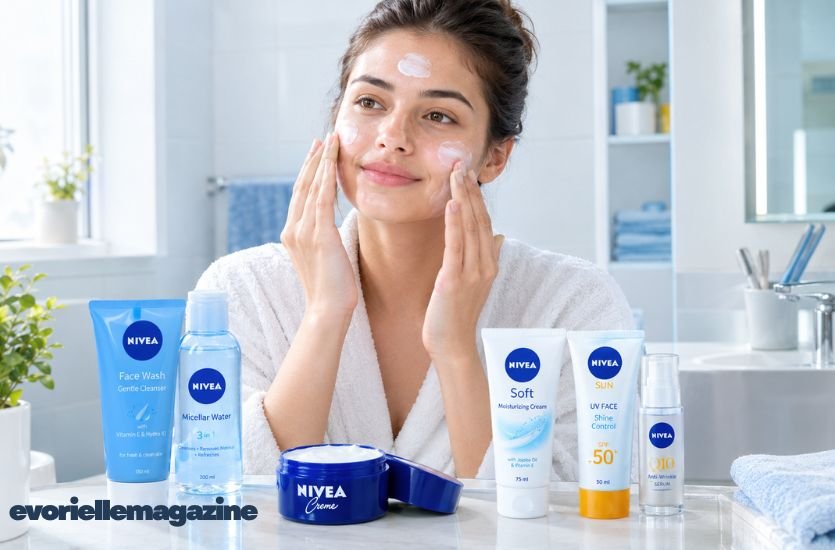
Starting skincare can feel surprisingly complicated. Walk into a pharmacy, supermarket, or beauty store and you can quickly find yourself surrounded by cleansers, moisturizers, micellar waters, serums, masks, exfoliators, vitamin C products, acne treatments, and sunscreens. For someone who has never followed a routine before, the biggest challenge is often not finding a product but knowing where to begin.
That is why the question, “I’m a skincare beginner. Is NIVEA a good starting brand compared to Garnier?”, makes perfect sense. Both brands are familiar, widely available, and positioned within the affordable skincare market. Both offer products that can fit into a beginner routine, but they do not approach skincare in exactly the same way.
NIVEA is particularly associated with moisturizing, creams, everyday skin comfort, and straightforward hydration. Garnier has a broader reputation for cleansing, micellar water, brightening products, vitamin C, and formulas aimed at specific concerns. Recent comparisons generally describe NIVEA as the simpler hydration-focused option while Garnier offers more targeted choices.
So, is NIVEA a good starting brand? Yes, it can be. But the smartest answer is more nuanced: NIVEA may be especially suitable for a beginner who wants a simple moisturizing routine, while Garnier may appeal more to someone who already knows they want to address concerns such as oiliness, dullness, or blemishes.
The best starting point is therefore not the logo on the bottle. It is understanding what your skin actually needs.
Quick Skincare Comparison Table
| Factor | NIVEA | Garnier |
|---|---|---|
| Main strength | Hydration and everyday moisturizing | Cleansing and targeted skincare |
| Beginner-friendly | Yes | Yes |
| Dry skin | Particularly suitable with the right product | Good with suitable formulas |
| Oily skin | Product-dependent | Many targeted options |
| Dull-looking skin | Some suitable products | Strong focus on brightening |
| Active ingredients | Available, but not the central identity of every range | Prominent in many targeted ranges |
| Simple routine | Excellent | Excellent |
| Best beginner approach | Start with basic hydration | Start simple and add targeted products when needed |
The comparison is a general guide rather than a rule. Both brands have extensive product ranges, so an individual product can behave very differently from another product within the same brand.
Why NIVEA Can Be a Good First Skincare Brand
One of NIVEA’s biggest advantages for a beginner is familiarity. The brand has long been associated with basic moisturizing and everyday skin care, which makes it less intimidating for someone who does not yet understand complicated skincare routines.
A beginner does not necessarily need a shelf full of specialized treatments. In fact, starting with too many products can make skincare harder rather than easier. A simple routine can help you understand how your skin behaves before you introduce additional ingredients.
NIVEA’s moisturizing reputation makes it particularly interesting for people whose first concern is dryness. If your skin often feels tight after washing, looks flaky, or becomes uncomfortable in dry weather, a suitable NIVEA moisturizer may provide the kind of basic support you are looking for.
The important word is suitable. NIVEA is a large brand rather than a single formula, and not every NIVEA product will be appropriate for every person.
That distinction is important because beginners sometimes make the mistake of thinking that choosing a good brand automatically means every product from that brand will work for them. Skin does not work that way. The formulation, ingredients, texture, fragrance, and intended skin concern all matter.
NIVEA and the Appeal of Simple Hydration
For someone completely new to skincare, hydration is a sensible place to start.
The skin naturally has a protective barrier that helps limit moisture loss and protects against external irritants. When that barrier becomes compromised, skin can feel dry, rough, tight, or uncomfortable.
This is one reason moisturizing products can be useful in a beginner routine. Rather than immediately trying to change every visible feature of the skin, a beginner can first establish basic cleansing and moisturizing habits.
NIVEA’s product identity fits naturally into this approach. Its classic creams and other moisturizing products have made hydration one of the company’s strongest associations.
This can make NIVEA feel less complicated than brands whose shelves are dominated by products aimed at individual concerns. A beginner looking for a moisturizer does not necessarily need to understand a long list of active ingredients before making a reasonable first choice.
That does not mean simple automatically means perfect. A rich cream may be comfortable on dry skin but feel too heavy for someone with oily skin. Likewise, a fragranced formula may not be ideal for someone whose skin reacts easily to fragrance.
The lesson is straightforward: NIVEA can be simple, but you still need to read the individual product label.
Where Garnier Can Be the Better Choice
Garnier takes a somewhat different route.
The brand is widely associated with products such as micellar cleansing water and skincare ranges that focus on particular concerns. Its portfolio includes products aimed at cleansing, hydration, brightening, oiliness, and other common skincare goals.
For a beginner who already knows what they want to address, that variety can be useful.
Imagine someone who does not primarily struggle with dryness but instead feels that their skin looks dull. Another person may be concerned about excess oil. Someone else may regularly deal with blemishes. In these situations, Garnier’s targeted approach may make the brand particularly appealing.
Some Garnier products feature ingredients such as vitamin C or salicylic acid. These ingredients can have legitimate skincare roles, but their presence also means a beginner needs to pay more attention to what they are using and how frequently they are using it.
This is where Garnier’s biggest advantage can also become a beginner’s biggest challenge.
More choices can be helpful, but too many choices can create confusion.
NIVEA vs Garnier for Dry Skin
If dryness is your primary concern, NIVEA has a strong case.
Rich moisturizing formulas can be useful when the skin feels tight or flaky, particularly when environmental conditions make dryness worse. Many beginners also find that a comfortable moisturizer makes it easier to maintain a routine because the immediate sensory experience is reassuring.
Garnier is not unsuitable for dry skin. The brand also has hydrating products, and the exact formulation matters more than the brand name.
However, if your first skincare goal is simply to establish hydration and comfort, NIVEA’s traditional strength in moisturizing makes it an obvious brand to investigate.
A beginner with dry skin should still avoid assuming that the thickest possible cream is automatically the best solution. If a product feels uncomfortable, excessively greasy, or causes irritation, it may simply not be the right formula for that particular person.
The goal is comfortable, consistent hydration rather than maximum heaviness.
Which Brand Is Better for Oily Skin?
The answer becomes less straightforward when oily skin enters the conversation.
People with oily skin often assume they should avoid moisturizer completely. That is not necessarily a good strategy. Skin can be oily and still need hydration.
Garnier may have an advantage here because its product ranges include options designed around cleansing and concerns associated with oily or blemish-prone skin. Its targeted approach can make it easier for someone to find a product that matches a specific concern.
NIVEA can still work for oily skin, but product selection becomes particularly important. A very rich moisturizer may feel uncomfortable on someone who already dislikes a heavy finish.
For an oily-skinned beginner, a lightweight moisturizer and gentle cleanser may be more useful than simply choosing the richest cream available.
The most important point is not to treat oiliness as a reason to abandon moisturizing altogether. A balanced routine is generally more practical than aggressively stripping the skin.
What About Sensitive Skin?
Sensitive skin requires more caution than simply choosing one brand and declaring it safe.
This is an important area where the phrase “NIVEA is better for sensitive skin” can be too broad.
NIVEA has products specifically designed for sensitive skin, including formulations that emphasize gentle care. The company itself notes that strong cleansers, acids, and perfumes can trigger irritation in sensitive skin.
At the same time, not every NIVEA product is fragrance-free, and some classic products contain fragrance components. Therefore, someone with reactive skin should inspect the exact formulation rather than assuming that the entire NIVEA range is automatically gentle.
The same principle applies to Garnier.
A fragrance-free, uncomplicated Garnier product could be a better choice for one person than a heavily fragranced NIVEA product. Conversely, another person may prefer a particular NIVEA sensitive-skin formula.
For sensitive skin, the best approach is therefore product first, brand second.
If you have persistent redness, significant irritation, eczema, rosacea, or another skin condition, it is also sensible to seek professional medical advice rather than trying to solve the problem through brand comparisons alone.
The Role of Active Ingredients
The word “active” can make skincare sound more advanced than it really is.
Vitamin C, salicylic acid, niacinamide, and other ingredients appear frequently on modern skincare shelves. Garnier offers products incorporating several targeted ingredients, which can be attractive to beginners who want visible changes beyond basic hydration.
But active ingredients should not be treated as trophies.
A product containing more actives is not automatically superior to a simple moisturizer. If your skin is dry, irritated, or inexperienced with skincare, adding multiple treatment products simultaneously can make it difficult to understand what your skin actually likes.
This is particularly important for beginners because irritation can be mistaken for a product “working.”
Burning, persistent redness, excessive dryness, or peeling should not simply be accepted as proof that a skincare product is effective.
A better approach is to introduce new products gradually and give yourself enough time to understand how your skin responds.
Why Beginners Should Not Build a Ten-Step Routine
One of the biggest misconceptions about skincare is that more steps equal better skin.
A beginner can easily start with cleanser, toner, serum, exfoliator, mask, eye cream, moisturizer, face oil, overnight treatment, and sunscreen. That may look impressive on a bathroom shelf, but it can be completely unnecessary.
The American Academy of Dermatology emphasizes a straightforward foundation built around cleansing, moisturizing, and sun protection. It also warns that using too many products can increase the risk of irritation.
This makes the NIVEA-versus-Garnier debate much simpler.
You do not need to choose a brand for your entire bathroom cabinet.
You only need to find products that perform the basic jobs your skin requires.
A NIVEA moisturizer could be part of that routine. A Garnier cleanser could be another part. There is no skincare rule requiring every bottle to carry the same logo.
Can You Use NIVEA and Garnier Together?
Absolutely.
There is no meaningful benefit to forcing yourself to use only one brand.
In fact, combining products from NIVEA and Garnier can make sense when each product serves a different purpose. Someone might prefer a Garnier cleansing product and a NIVEA moisturizer. Another person could prefer a Garnier targeted treatment alongside a moisturizer from NIVEA.
The key is avoiding unnecessary duplication.
If you already have a gentle cleanser that works, you do not need another cleanser simply because it comes from a different brand. If your moisturizer keeps your skin comfortable, there may be no reason to replace it simply because another brand is trending.
Skincare should be built around function rather than brand loyalty.
A Simple Beginner Routine
For someone starting from zero, the best routine is usually much simpler than social media makes it appear.
In the morning, cleanse gently if your skin needs it, moisturize according to your skin type, and finish with a broad-spectrum sunscreen. Daily sun protection is particularly important because skincare should not only address how the skin looks today but also help protect it over time.
At night, cleanse away the day’s buildup, then apply your moisturizer.
That is enough to establish a foundation.
Once the routine feels comfortable and predictable, you can consider whether you actually need a targeted product. If you have a specific concern such as persistent acne, significant pigmentation, or another ongoing problem, the next step should be based on that concern rather than on whatever product happens to be popular.
This gradual approach also makes it easier to identify a problem if irritation develops.
NIVEA vs Garnier: Which Is More Beginner-Friendly?
If “beginner-friendly” means simple, understandable, and focused on basic moisturizing, NIVEA has a strong advantage.
If “beginner-friendly” means having a wide selection of targeted products for specific concerns, Garnier can be equally attractive.
That distinction explains why online comparisons can sometimes appear contradictory. One article may call NIVEA the clear winner because it focuses on simplicity, while another may recommend Garnier because the writer is considering acne, dullness, or oily skin.
Both perspectives can make sense.
The real question is not simply, “Which brand is better?”
The better question is:
“What does my skin need from my first routine?”
Once you answer that, the brand choice becomes much easier.
NIVEA for Beginners Who Want Basic Moisturization
NIVEA is particularly appealing if your skincare goal is uncomplicated.
Perhaps you have never used a moisturizer consistently. Perhaps your skin feels dry after showering. Perhaps you simply want something familiar and affordable rather than a complicated treatment system.
In those circumstances, NIVEA can be a sensible starting point.
Its strongest beginner argument is not that every NIVEA product is perfect. It is that the brand makes it relatively easy to understand the basic role of moisturizing in a skincare routine.
That can be valuable when you are learning.
Garnier for Beginners With a Specific Concern
Garnier becomes particularly interesting when you already have a defined goal.
If your main concern is dull-looking skin, you may want to explore its brightening-focused products. If you are interested in cleansing and makeup removal, micellar water may be relevant. If you have oily or blemish-prone skin, products featuring ingredients such as salicylic acid may appear more relevant.
But targeted products require targeted thinking.
Do not buy a vitamin C product, salicylic acid product, exfoliator, mask, and serum simply because each one promises a different benefit.
Pick the concern that matters most and introduce one new product at a time.
That is a much better beginner strategy.
What Matters More Than Choosing NIVEA or Garnier?
The most important factor is consistency.
A relatively simple routine used consistently is usually more practical than an elaborate routine used for three days before becoming overwhelming.
Your skin also needs time.
If you introduce several products simultaneously and experience irritation, you may have no idea which product caused it. If you introduce products gradually, you have a much clearer picture of what works for you.
Your skin type matters too.
Dry skin may prefer richer textures. Oily skin may prefer lighter products. Combination skin may require a balance between the two. Sensitive skin requires particularly careful attention to fragrance and potentially irritating ingredients.
And above everything else, the exact product matters.
The NIVEA logo does not guarantee that every NIVEA formula will suit you. The Garnier logo does not mean every Garnier product will be appropriate either.
Common Beginner Mistakes to Avoid
One of the most common mistakes is changing products constantly.
A beginner may use one moisturizer for several days, decide it is not producing dramatic results, and immediately replace it. This makes it difficult to establish a consistent routine.
Another mistake is using too many new products at once. If your skin reacts, you will not know which product is responsible.
A third mistake is ignoring sunscreen.
Moisturizer can improve comfort and hydration, but sun protection is an essential part of a sensible daytime routine. AAD guidance recommends broad-spectrum SPF 30 or higher.
Another common mistake is assuming that expensive skincare is automatically better. A beginner does not need luxury packaging to create a sensible routine.
The fundamentals matter much more.
Frequently Asked Questions
Is NIVEA good for someone completely new to skincare?
Yes. NIVEA can be a good starting brand, particularly for someone who wants straightforward moisturizing and a simple routine. However, the specific product should still be selected according to skin type and formulation.
Is Garnier better than NIVEA for beginners?
Not universally. Garnier may be more attractive to beginners who want targeted products for concerns such as dullness, oiliness, cleansing, or blemishes, while NIVEA may be more appealing to those prioritizing basic hydration.
Is NIVEA better for dry skin?
NIVEA can be a strong choice for dry skin because moisturizing is one of its most established product categories. The best choice still depends on the exact formula and how your skin responds.
Is Garnier better for oily skin?
Garnier offers several products designed around cleansing and targeted concerns associated with oily or blemish-prone skin, so it can be an attractive option. However, oily skin still needs appropriate hydration.
Can I use NIVEA and Garnier together?
Yes. There is no requirement to use a single brand. Combining products can be perfectly reasonable when each product serves a useful purpose and the overall routine remains simple.
Should a beginner use vitamin C or salicylic acid immediately?
Not necessarily. If you are completely new to skincare, establishing a basic cleanser, moisturizer, and sunscreen routine first can make it easier to understand your skin. Targeted actives can be introduced later when there is a specific reason to use them.
Does sensitive skin automatically mean NIVEA is better?
No. Sensitive skin should be assessed at the product level rather than by brand name. Look carefully at the formulation, especially fragrance and potentially irritating ingredients. NIVEA does have products specifically formulated for sensitive skin, but not every product in its range is identical.
The Final Verdict
So, “I’m a skincare beginner. Is NIVEA a good starting brand compared to Garnier?”
Yes, NIVEA can be an excellent starting brand, particularly if your priority is simple hydration, comfortable skin, and an uncomplicated routine. Its moisturizing-focused reputation makes it a natural option for beginners who do not yet want to experiment with multiple active ingredients.
But Garnier should not be dismissed.
Garnier can be the better starting point when a beginner already has a particular goal in mind, such as cleansing, dullness, oiliness, or blemish-related concerns. Its broader selection of targeted products gives beginners more ways to address specific issues.
Ultimately, NIVEA versus Garnier is not really a competition with one universal winner. The better choice depends on your skin, your routine, and the exact product you are considering.
If you are completely new to skincare and have no major concern, start with the basics. Keep the routine simple, introduce products gradually, moisturize appropriately, and make daily sun protection part of your routine.
Once you understand how your skin behaves, you can decide whether you need anything more.
That is the real secret to beginner skincare: you do not need the biggest collection of products. You need the smallest routine that works comfortably and consistently for you.
READ MORE ABOUT : MagFuseHub Com
READ MORE ABOUT : HCOOCH CH2 H2O

One thought on “I’m a Skincare Beginner. Is NIVEA a Good Starting Brand Compared to Garnier?”