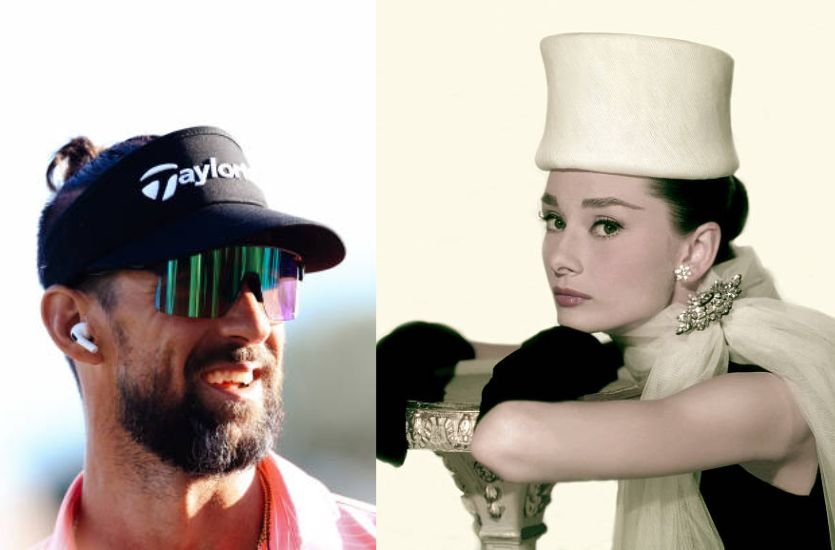
Michael Phelps and Audrey Hepburn are two names that continue to attract worldwide attention, but for very different reasons. Phelps became one of the most successful Olympic swimmers in history, while Hepburn became an internationally celebrated actress and later a dedicated UNICEF humanitarian. Their careers belonged to different generations and industries, yet both built legacies that extended far beyond their original professions.
Quick Bio: Michael Phelps
| Detail | Information |
|---|---|
| Full Name | Michael Fred Phelps II |
| Date of Birth | June 30, 1985 |
| Birthplace | Baltimore, Maryland, USA |
| Profession | Former competitive swimmer |
| Specialty | Butterfly, individual medley, freestyle, backstroke |
| Olympic Appearances | 2000, 2004, 2008, 2012, 2016 |
| Olympic Medals | 28 |
| Olympic Gold Medals | 23 |
| Silver Medals | 3 |
| Bronze Medals | 2 |
| Nickname | The Baltimore Bullet |
| Coach | Bob Bowman |
Michael Phelps was born in Baltimore, Maryland, on June 30, 1985. He began swimming at a young age and eventually developed into an elite international competitor. Team USA records that he began swimming at seven and later competed for Towson High School and the University of Michigan.
Quick Bio: Audrey Hepburn
| Detail | Information |
|---|---|
| Full Name | Audrey Kathleen Hepburn |
| Date of Birth | May 4, 1929 |
| Birthplace | Brussels, Belgium |
| Profession | Actress and humanitarian |
| Major Breakthrough | Roman Holiday |
| Famous Films | Roman Holiday, Sabrina, Breakfast at Tiffany’s, My Fair Lady |
| UNICEF Role | Goodwill Ambassador |
| UNICEF Service | 1988–1993 |
| Presidential Medal of Freedom | 1992 |
| Date of Death | January 20, 1993 |
| Age at Death | 63 |
Audrey Hepburn was born in Brussels, Belgium, in 1929. She became one of the most recognizable actresses of the twentieth century before devoting a significant part of her later life to humanitarian work with UNICEF. UNICEF records that she served as a Goodwill Ambassador from 1988 until 1993.
Who Was Michael Phelps?
Michael Phelps became internationally famous through competitive swimming. His career was built around extraordinary performances at the Olympic Games, where he competed for the United States across five editions between 2000 and 2016.
His Olympic career began at the Sydney 2000 Games. Although he did not win a medal there, his participation at only 15 years old marked the beginning of a remarkable Olympic journey. Over the next four Olympic Games, his medal total increased dramatically.
At Athens in 2004, Phelps won six gold medals and two bronze medals. At Beijing in 2008, he entered eight swimming events and won gold in all eight, establishing one of the most memorable achievements in Olympic swimming. Olympedia records that his Beijing performance made him the first Olympian to win eight gold medals at a single Olympic Games.
His success continued at London in 2012, where he added six medals, including four gold. He later returned for the 2016 Rio de Janeiro Olympics and won six additional medals, five of them gold. By the end of his Olympic career, he had accumulated 28 medals, consisting of 23 gold, three silver, and two bronze.
Michael Phelps and the Olympic Record
The phrase Michael Phelps and Olympic records are closely associated because of the scale of his medal achievements. Olympedia’s historical medal table lists Phelps at the top with 23 gold medals, three silver medals, two bronze medals, and 28 total Olympic medals.
His achievements were not limited to a single swimming discipline. Phelps competed in butterfly, individual medley, freestyle, and backstroke. His versatility allowed him to participate in individual races as well as relay events.
His performances at Beijing 2008 remain particularly significant. Winning eight gold medals at one Games required success across several events and demonstrated his ability to perform repeatedly under Olympic pressure.
Phelps’s career also illustrates how long-term sporting success can depend on more than natural ability. Training, technical development, coaching, competition experience, and preparation all played important roles in his progression from a teenage Olympian to a record-setting athlete.
Michael Phelps and His Return to the Olympics
Phelps announced his retirement after the 2012 Olympics but later returned to competitive swimming. His comeback eventually led to another Olympic appearance at Rio 2016.
At Rio, he won five gold medals and one silver medal. His final Olympic appearance therefore added another six medals to an already extraordinary record. Olympedia records that his Rio results brought his career Olympic total to 28 medals and 23 gold medals.
His retirement after Rio 2016 marked the end of a competitive Olympic career that had lasted more than a decade and a half.
Who Was Audrey Hepburn?
Audrey Hepburn followed a completely different path. Rather than becoming famous through sport, she rose to international prominence through cinema.
Born in Brussels in 1929, Hepburn studied ballet and later became involved in acting. UNICEF describes her early career as developing through European stage and film opportunities before she received the leading role in Roman Holiday.
Roman Holiday became a major turning point. Hepburn starred opposite Gregory Peck and received the Academy Award for Best Actress for her performance. The film established her as an international movie star.
Her subsequent career included some of the most recognizable films of the era. Her screen work included Sabrina, Funny Face, Breakfast at Tiffany’s, Charade, My Fair Lady, and other major productions.
Hepburn’s public image became associated not only with acting but also with fashion and elegance. Her influence continued long after many of her most famous films were released.
Audrey Hepburn’s Humanitarian Work
One of the most important aspects of Audrey Hepburn’s life was her work with UNICEF.
Hepburn became a UNICEF Goodwill Ambassador in 1988. Her work took her to several countries where she visited projects involving children and families affected by poverty, disease, hunger, displacement, and other difficult circumstances. UNICEF records missions involving countries including Ethiopia, Turkey, Venezuela, Ecuador, Guatemala, Honduras, El Salvador, Bangladesh, Thailand, Vietnam, and Sudan.
Her personal history also influenced her relationship with humanitarian work. Hepburn experienced wartime hardship as a child in Europe. UNICEF records her recollection of receiving food and medical assistance after the Second World War and her long-standing gratitude toward organizations providing relief to children.
This background helped give additional meaning to her later public service. Instead of using her international fame only for entertainment and commercial opportunities, she used it to bring attention to humanitarian issues.
Audrey Hepburn and UNICEF
Hepburn’s UNICEF work became a major part of her later legacy. She traveled internationally, spoke with journalists, visited humanitarian projects, and participated in campaigns designed to raise awareness of children’s needs.
Her involvement was not simply symbolic. UNICEF records that she visited field programs and spoke publicly about what she saw. She also testified before the United States Congress and participated in international events focused on children’s welfare.
In 1992, Hepburn received the Presidential Medal of Freedom, one of the United States’ highest civilian honors. UNICEF notes that she continued humanitarian work during that period despite serious illness.
She died at her home in Switzerland on January 20, 1993.
Michael Phelps and Audrey Hepburn: Is There a Direct Connection?
The keyword “Michael Phelps and Audrey Hepburn” can suggest that the two people had a shared career, relationship, or major historical event connecting them. Available authoritative biographies do not establish such a direct connection.
Their lives did overlap briefly. Hepburn was born in 1929 and died in 1993, while Phelps was born in 1985. This means Phelps was a young child during the final years of Hepburn’s life.
Their professional careers also developed in very different periods. Hepburn’s major international film career began in the 1950s, while Phelps’s Olympic career became prominent decades later.
Therefore, an accurate article should treat the two as separate figures rather than suggesting they were colleagues, friends, relatives, or collaborators.
Two Different Paths to International Recognition
The most interesting aspect of Michael Phelps and Audrey Hepburn is the contrast between their careers.
Phelps achieved global recognition through physical performance and competitive sport. His career was measured through races, medals, world championships, Olympic appearances, and records.
Hepburn achieved international recognition through acting and later humanitarian service. Her career was first measured through films and awards, while her later public work was associated with UNICEF and children’s rights.
Their professions could hardly be more different, but their public influence extended beyond their primary occupations.
Michael Phelps and Audrey Hepburn as Global Icons
Phelps became a recognizable figure because swimming provided a global stage through the Olympic Games. The Olympics allowed audiences around the world to follow his performances and compare his achievements with those of other elite athletes.
Hepburn gained a similar international audience through cinema. Hollywood films distributed internationally allowed her performances and public image to reach audiences far beyond the United States.
In both cases, fame was created through professional achievement but eventually developed into something broader.
Phelps became associated with Olympic excellence and the history of swimming. Hepburn became associated with classic cinema, fashion, and humanitarian work.
Their Influence Beyond Their Main Careers
Michael Phelps’s post-competition activities have included continued involvement with swimming and charitable work. Team USA states that the Michael Phelps Foundation focuses on mental and physical well-being and empowering people to pursue their goals.
Hepburn’s influence beyond acting was particularly visible through UNICEF. Her humanitarian activities became an important part of the way her life is remembered. UNICEF continues to list her among its legacy ambassadors.
This distinction is useful when discussing the two figures. Phelps’s most prominent historical achievement remains his Olympic record, while Hepburn’s legacy combines her cinematic career with her later humanitarian contribution.
Michael Phelps and Audrey Hepburn in Popular Culture
Both names remain recognizable decades after their most important professional achievements.
Phelps continues to be associated with Olympic swimming and the record number of Olympic medals he accumulated. His name frequently appears in discussions about Olympic history and elite swimming.
Hepburn remains a prominent figure in discussions of classic Hollywood, fashion history, film, and humanitarian work. Her photographs, films, and public image continue to appear in modern media.
The reasons for their continuing recognition are therefore different. Phelps represents a historic sporting achievement, while Hepburn represents a combination of cinema, cultural influence, and humanitarian service.
What Michael Phelps and Audrey Hepburn Have in Common
Although there is no major documented personal connection between them, several broad similarities can be identified.
Both became internationally recognizable through careers that demanded sustained public performance. Phelps competed before enormous Olympic audiences, while Hepburn performed for international film audiences.
Both also developed identities that went beyond their original professional roles. Phelps became more than a swimmer in the public imagination because of the scale of his Olympic achievements and later charitable involvement. Hepburn became more than an actress because of her humanitarian work with UNICEF.
Another similarity is the lasting nature of their public legacies. Phelps retired from competitive swimming after Rio 2016, but his Olympic records remain an important part of sports history. Hepburn died in 1993, yet her films and humanitarian legacy continue to receive attention.
Why Michael Phelps Remains Important in Sports History
Phelps’s importance comes primarily from the extraordinary scale and consistency of his Olympic results.
Twenty-eight Olympic medals represent success across five Games and multiple swimming events. His 23 gold medals are particularly notable in the history of the Olympic Games. Olympedia’s medal statistics continue to place him at the top of its all-time Olympic medal table.
His career also provides an example of how an athlete can remain competitive across multiple Olympic cycles. From his first appearance in Sydney in 2000 to his final competition in Rio in 2016, Phelps remained a major presence in international swimming.
Why Audrey Hepburn Remains Important in Film and Humanitarian History
Hepburn’s importance is not limited to her most famous movie roles.
Her film career established her as one of the most recognizable actresses of her generation. However, her later work with UNICEF added another dimension to her public legacy.
UNICEF describes her as an advocate for children’s rights and documents her extensive international travel on behalf of the organization.
Her life therefore connects two different forms of public influence: entertainment and humanitarian advocacy.
A Lasting Legacy of Two Different Kinds
Michael Phelps and Audrey Hepburn represent two very different ways a public figure can become historically significant.
Phelps’s legacy is centered on measurable athletic achievements. His Olympic medal count provides a clear numerical record of his success, with 28 total medals and 23 gold medals.
Hepburn’s legacy is more diverse. Her film career made her a major cultural figure, while her UNICEF service gave her public life a humanitarian dimension. UNICEF continues to preserve and promote the history of her work as one of its former Goodwill Ambassadors.
The two should therefore not be presented as a famous partnership. Instead, the keyword “Michael Phelps and Audrey Hepburn” can be used to explore how two internationally known figures from different generations created enduring legacies through very different forms of achievement.
Final Thoughts
Michael Phelps and Audrey Hepburn came from different generations and became famous through entirely different professions. Phelps transformed competitive swimming through an Olympic career that produced 28 medals, including 23 gold medals. Hepburn became a major film star before dedicating much of her later public life to UNICEF and children’s humanitarian causes.
There is no established major personal or professional relationship between the two. Their relevance together comes from the broader idea of international fame and lasting legacy. Phelps represents extraordinary achievement in Olympic sport, while Hepburn represents the combination of cinematic influence and humanitarian service.
Their stories demonstrate that public legacies can take very different forms. One can be built through records and medals, while another can grow through films, cultural influence, and service to others. That contrast makes Michael Phelps and Audrey Hepburn an interesting pair for understanding two very different paths to worldwide recognition.
READ MORE ABOUT : Lachlan Murdoch and David Cordani
READ MORE ABOUT : Aretha Franklin and Kathy Warden

One thought on “Michael Phelps and Audrey Hepburn: Two Remarkable Legacies”