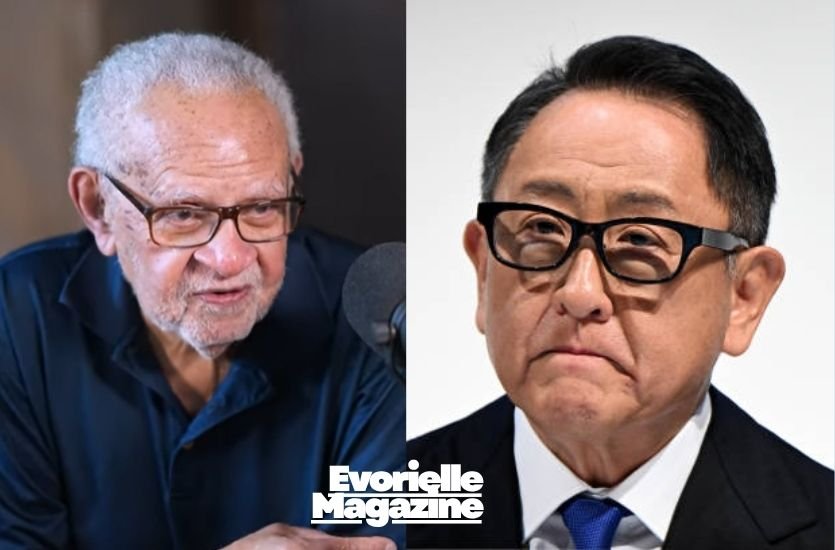
Richard Peery and Akio Toyoda come from different countries, industries, and professional backgrounds, yet both have built notable careers over several decades. Peery became known for commercial real estate development in Silicon Valley, while Toyoda spent his career at Toyota Motor Corporation and eventually became chairman of the company’s board. Their stories provide an interesting comparison between real estate entrepreneurship and global automotive leadership.
Although Richard Peery and Akio Toyoda are sometimes discussed together online, there is no well-documented direct business partnership, family connection, or joint venture between them. Their relevance as a pair comes from the contrast between their careers. Peery built his reputation through property investment and development alongside John Arrillaga, while Toyoda developed extensive experience within Toyota before becoming president and later chairman.
Quick Bio of Richard Peery and Akio Toyoda
| Details | Richard Peery | Akio Toyoda |
|---|---|---|
| Full Name | Richard “Dick” Peery | Akio Toyoda |
| Birth | 1930s | May 3, 1956 |
| Nationality | American | Japanese |
| Main Industry | Commercial Real Estate | Automotive |
| Major Organization | Peery-Arrillaga | Toyota Motor Corporation |
| Education | Brigham Young University; attended Stanford MBA program | Keio University; Babson College |
| Major Business Association | John Arrillaga | Toyota Motor Corporation |
| Notable Role | Silicon Valley real estate developer | Chairman of Toyota |
| Known For | Commercial property development | Toyota leadership and automotive strategy |
Who Is Richard Peery?
Richard Peery is an American businessman whose career is closely associated with Silicon Valley commercial real estate. His name became particularly prominent through his long-running partnership with John Arrillaga, with whom he developed commercial properties in an area that later became one of the world’s most important technology centers.
Forbes describes Peery as a real-estate businessman and reports that he gained early experience managing his father’s small property portfolio. His business career eventually expanded into larger commercial developments, particularly through the Peery-Arrillaga partnership. Forbes also reports that Peery attended Brigham Young University and later entered Stanford’s MBA program without completing it.
Peery’s story is notable because his career developed alongside the transformation of Silicon Valley. Instead of becoming a technology entrepreneur himself, he participated in the region’s growth by developing the physical commercial infrastructure that technology companies needed.
Richard Peery’s Early Business Background
Peery’s early life included exposure to business and property management. According to Forbes, he managed a small property portfolio belonging to his father, giving him practical exposure to real estate at an early stage of his career. His entrepreneurial interests also appeared unusually early. Forbes reports that Peery owned every gumball machine on the Stanford campus when he was in middle school and later launched a miniature-golf course during his teenage years.
These early activities do not by themselves explain his later success, but they provide useful context for understanding the entrepreneurial side of his career. Rather than following a conventional corporate path, Peery became increasingly involved in property and commercial development.
His education also took an unconventional route. Forbes identifies Brigham Young University as his undergraduate institution and notes that he later dropped out of Stanford’s MBA program. His career therefore became more strongly associated with practical real-estate experience than with completing an advanced business degree.
Richard Peery and John Arrillaga
The most important part of Richard Peery’s professional story is his partnership with John Arrillaga. The two businessmen began working together in the 1960s, when Silicon Valley was still developing into the technology center recognized today.
Stanford Report explains that Peery and Arrillaga bought fruit orchards around Stanford University and began developing the land into office parks. Their strategy was closely connected to the expansion of technology companies in the region. Over time, their company, Peery-Arrillaga, became one of Silicon Valley’s significant commercial real-estate developers.
The importance of this partnership was not simply the amount of property involved. It also reflected the changing economic geography of California. Agricultural land around Stanford was increasingly positioned near companies, researchers, and technology businesses that required modern office space.
Stanford reports that Peery-Arrillaga eventually leased office space to companies including Intel, Apple, Facebook, and Google. This placed the partnership directly within the physical development of an area that became central to the technology economy.
Richard Peery’s Silicon Valley Real Estate Career
Peery’s career illustrates how commercial real estate can become connected to wider economic development. Technology companies require offices, research facilities, production-related properties, and other forms of infrastructure. As Silicon Valley expanded, suitable commercial property became increasingly valuable.
Forbes has described Peery and Arrillaga as major Silicon Valley commercial landlords who purchased farmland during the 1960s and converted it into office space. The partnership’s approach involved acquiring land and developing properties rather than simply focusing on short-term property transactions.
One of the most significant transactions associated with the partnership occurred in 2006. Forbes reports that Peery and Arrillaga sold many of their buildings for approximately $1.1 billion. Historical Forbes records also identify the two as major Silicon Valley commercial landlords.
This transaction became an important milestone in Peery’s real-estate career because it demonstrated the substantial value that had accumulated in properties developed during the preceding decades.
Richard Peery’s Philanthropic Activities
Richard Peery’s public profile also includes philanthropy and education. Forbes reports that Peery and his sister provided a $3 million endowment to Brigham Young University to establish the H. Taylor Peery Institute of Financial Services, named after their father.
This aspect of his career adds another dimension to the story. Peery’s public record is not limited to property development and wealth. His family has also been involved in supporting educational activities connected with financial services.
The Peery Foundation, associated with his family, has also supported nonprofit organizations. Forbes notes that Peery’s son Dave runs the foundation, whose grantees include organizations in the Bay Area and internationally.
Who Is Akio Toyoda?
Akio Toyoda is a Japanese business executive best known for his long career at Toyota Motor Corporation. He became president of Toyota in 2009 and moved into the position of chairman of the board in April 2023. Toyota’s current executive information lists him as chairman of the board of directors and representative director.
Toyoda was born on May 3, 1956. He graduated from Keio University with a degree in law in 1979 and subsequently earned a master’s degree in business administration from Babson College in the United States in 1982. He joined Toyota in April 1984.
His career is significant because he did not simply move immediately into the company’s highest leadership position. Toyota’s official biography records experience across production, marketing, product development, international operations, purchasing, quality, and other areas of the automotive business.
Akio Toyoda’s Early Career at Toyota
After joining Toyota in 1984, Toyoda developed experience across different parts of the automotive organization. His international experience became particularly important.
In 1998, Toyoda became an executive vice president and board member at New United Motor Manufacturing, Inc., commonly known as NUMMI. NUMMI was Toyota’s production joint venture with General Motors in California. This assignment gave Toyoda experience within an American manufacturing environment and exposed him to international automotive operations.
Toyoda returned to Japan in 2000 and was appointed to Toyota’s board of directors later that year. His responsibilities subsequently included areas such as marketing, operations in the Americas, production management consulting, and regional operations.
By 2005, he had become an executive vice president and representative director, with responsibilities covering areas including information technology, quality, product management, purchasing, Japanese and overseas sales, and international operations.
Akio Toyoda Becomes Toyota President
Akio Toyoda became president of Toyota Motor Corporation in June 2009. His appointment came during a difficult period for the global automotive industry, following the financial crisis and major changes in the automobile market.
His presidency lasted for approximately 14 years. During that period, Toyota continued developing vehicles and technologies while dealing with changing customer expectations, global competition, environmental concerns, and changes in the automotive industry.
Toyota’s official biography confirms that Toyoda remained president until April 2023, when he became chairman of the company.
His transition from president to chairman did not represent an end to his involvement with Toyota. Current Toyota corporate information continues to identify Akio Toyoda as chairman of the board of directors.
Akio Toyoda and the Morizo Identity
One distinctive aspect of Akio Toyoda’s public career is his connection with motorsports. He has participated in racing under the name “Morizo,” creating a personal connection between Toyota’s corporate leadership and automotive competition.
His interest in driving and motorsports has become an important part of his public identity. Rather than being known solely as a corporate executive, Toyoda has also been associated with vehicle development, racing, and Toyota’s motorsports activities.
Toyota’s 2026 motorsports material continues to identify Akio Toyoda as chairman of Toyota Motor Corporation and chairman of Toyota Gazoo Racing World Rally Team.
This background helps explain why Toyoda’s career has often been discussed not only in terms of corporate management but also in relation to automobiles, driving, engineering, and motorsports.
Richard Peery and Akio Toyoda: Different Business Worlds
Richard Peery and Akio Toyoda are associated with fundamentally different industries. Peery built his reputation through commercial real estate, while Toyoda developed his career in automotive manufacturing and corporate management.
Peery’s major professional partnership was with John Arrillaga. Together, they acquired and developed land in Silicon Valley and built commercial office properties. Toyoda’s career, in contrast, developed inside Toyota, where he moved through numerous operational and executive responsibilities before becoming president and chairman.
Their careers therefore should not be presented as if they were part of the same company or business network. There is no reliable evidence establishing a direct business partnership or family connection between Richard Peery and Akio Toyoda.
Instead, the value of comparing them lies in examining how two business figures developed long careers in very different economic environments.
Comparing Their Career Paths
Richard Peery’s career was strongly entrepreneurial. His work involved property acquisition, development, leasing, and long-term commercial real-estate management. His partnership with Arrillaga became particularly important as Silicon Valley expanded around Stanford and the wider Santa Clara Valley.
Akio Toyoda followed a more structured corporate career. He joined Toyota in 1984 and gradually took on responsibilities in different parts of the company. His experience included international operations, manufacturing-related activities, marketing, product development, quality, purchasing, and sales before he became president.
The contrast is important. Peery’s career demonstrates the role of private property development in an expanding regional economy, while Toyoda’s career demonstrates how long-term experience within a multinational manufacturer can lead to senior corporate leadership.
Long-Term Development in Their Careers
A common feature of both stories is the length of time involved in building their professional reputations. Peery’s major real-estate developments were connected to property decisions made decades before Silicon Valley became globally dominant. Stanford’s account of the Peery-Arrillaga partnership shows how their early office developments grew alongside the technology sector.
Toyoda similarly spent decades inside Toyota. He joined the company in 1984, became a board member in 2000, became executive vice president in 2005, president in 2009, and chairman in 2023.
These timelines show that both careers involved substantial professional development, although the industries and circumstances were very different.
Business Legacy of Richard Peery
Richard Peery’s legacy is closely associated with Silicon Valley commercial real estate and the Peery-Arrillaga partnership. The transformation of agricultural land into office developments occurred during a period when the surrounding region was becoming increasingly important to technology companies.
The historical importance of this work is partly visible through the companies that later occupied properties developed by Peery and Arrillaga. Stanford identifies companies such as Intel, Apple, Facebook, and Google among the technology firms that leased their office space.
His philanthropy also contributes to his public legacy. The $3 million endowment connected with the H. Taylor Peery Institute of Financial Services at Brigham Young University represents an extension of his family background in financial services into education.
Business Legacy of Akio Toyoda
Akio Toyoda’s legacy is primarily connected with Toyota’s global development and his long career within the automotive industry. His presidency began in 2009 and lasted until 2023, after which he became chairman.
His professional background covers multiple areas of automotive operations, including production, marketing, product development, quality, purchasing, sales, and international business.
His involvement with motorsports has also made him a distinctive figure within Toyota. His Morizo identity connects corporate leadership with his personal interest in driving and racing, while his continued role with Toyota Gazoo Racing reflects the importance of motorsports within his public career.
What Makes Richard Peery and Akio Toyoda Interesting to Compare?
The comparison between Richard Peery and Akio Toyoda is most useful when it focuses on their different professional paths rather than suggesting that they share a direct business connection.
Peery worked primarily through property investment and development. His career was closely connected to a specific geographic transformation, as Silicon Valley developed from an agricultural region into a major center of technology and business.
Toyoda worked within a global manufacturing company. His career required experience across multiple departments and geographic markets before he reached Toyota’s presidency and later chairmanship.
Their stories therefore illustrate two very different forms of business leadership. One developed commercial property alongside a rapidly growing regional economy, while the other spent decades navigating the operations of a multinational automotive company.
Final Thoughts
Richard Peery and Akio Toyoda represent two distinct paths through the business world. Peery became a prominent figure in Silicon Valley commercial real estate through his long partnership with John Arrillaga, while Toyoda built a decades-long career at Toyota that ultimately led to the company’s presidency and chairmanship.
Their backgrounds, industries, and responsibilities were different, and there is no established direct business relationship between them. What connects them as an article topic is the opportunity to compare two long professional journeys and the different environments in which they developed.
Richard Peery’s story is closely tied to land, office development, Silicon Valley, and philanthropy. Akio Toyoda’s story is connected with automotive manufacturing, international operations, Toyota leadership, and motorsports. Looking at the two together provides a broader view of how business careers can develop through very different routes while leaving significant marks on their respective industries.
READ MORE ABOUT : Michael Phelps and Audrey Hepburn
READ MORE ABOUT : Lachlan Murdoch and David Cordani
